
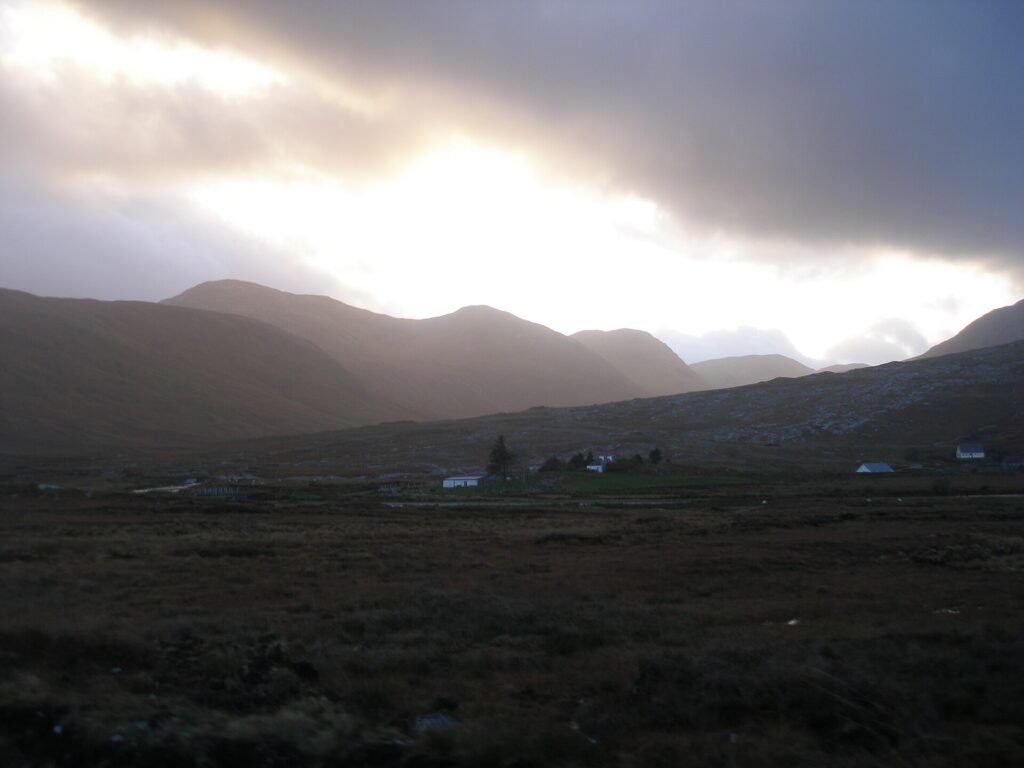
Driving is the best way to see Ireland and the part of the trip visitors worry about most. Most of that worry is misplaced, and the bits that should worry you are not the ones people expect.
The left is the easy part
You adapt within an hour. The reliable trick is to keep your own body nearer the centre line — as the driver you should always be on the side of the car closest to oncoming traffic. If you find yourself hugging the middle, you have drifted.
Roundabouts go clockwise and you give way to the right. Left turns are the tight ones; right turns cross traffic.
The roads that actually catch people out
Ireland’s road numbering tells you almost everything. M is motorway and fine. N is national and mostly fine. R is regional and can be anything. L is local, and an L road on a map may be a lane with grass growing down the middle of it.
Google Maps does not distinguish. It will route you down an L road to save four minutes and you will meet a tractor.
Speed limits change at the border
The Republic posts limits in kilometres per hour. Northern Ireland posts them in miles per hour. There is no checkpoint and often no sign to tell you that you have crossed. A hire car from Dublin will have a speedometer with both; check which ring you are reading.
Rural limits in the Republic are often 80km/h on roads where 50 would be brave. The number is a maximum, not a target.
Insurance is the expensive mistake
Most non-EU credit card rental insurance excludes Ireland by name. Ireland and Israel are the two standard exclusions on many US card policies. People decline the counter insurance on the strength of a card benefit that does not apply, and get a hold of three thousand euro or more on the card.
Ring your card issuer before you fly and ask about the Republic of Ireland specifically, not “Europe”. Get the answer in writing if you can.
Book an automatic early or learn to love a manual
Automatics are roughly double the price and sell out months ahead in summer. If you cannot drive a manual, this is the single thing to book first.
Take the smaller car
The upgrade is a trap. Lanes in Kerry, Clare and Donegal are genuinely narrow, hedges are stone underneath, and every scrape comes off your excess. A smaller car is easier everywhere and the boot is almost always enough.
Fuel, tolls and parking
Fill up before Beara, Slea Head or Donegal; stations thin out fast. The M50 around Dublin is barrier-free tolling — your hire company will bill you, usually with a fee. City parking is by app or disc; rural parking is mostly free and mostly informal.