
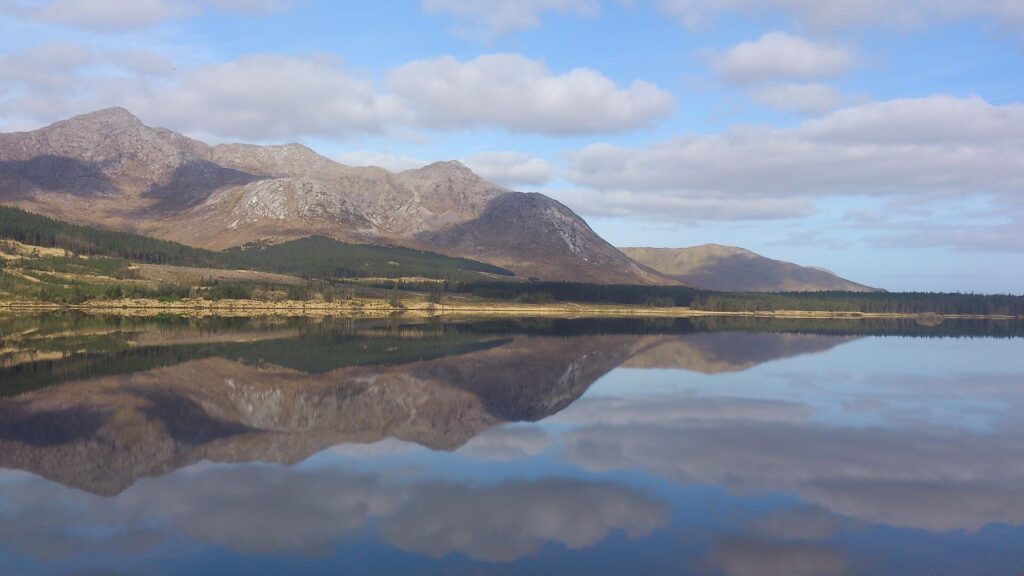
Connemara is the part of Ireland that looks least like anywhere else, and the region most often reduced to a day trip from Galway when it deserves considerably more.
Where it is
West of Galway city, bounded by Lough Corrib to the east and the Atlantic on three other sides. Bog, quartzite mountains, sea inlets and a scattering of small towns. The Irish language is still spoken daily in parts of it.
The drive
The classic loop runs Galway to Oughterard, up through Maam Cross to Leenane on the fjord, out to Kylemore, down to Clifden and back along the coast road through Roundstone. It is about 160km and takes a full day if you stop, which you will.
The Sky Road out of Clifden is 16km and worth every minute. Go anticlockwise for the sea on your side.
The stops that earn their place
Kylemore Abbey. The most photographed building in Connemara, a Victorian castle built for a wife who died at 45. The house is fine; the walled garden is the better half and most visitors skip it.
Killary Harbour. Ireland’s only true fjord, 16km long, with mussel rafts and a road that runs the length of it. The Famine Road walk along the north shore is flat and extraordinary.
Roundstone. A working harbour village with a bodhrán maker and a beach — Dog’s Bay — that looks Caribbean until you put a foot in the water.
Connemara National Park. Diamond Hill is a well-made loop with a genuine summit view for about three hours of effort. The best short walk in the west.
Why a day trip undersells it
A coach from Galway gives you Kylemore, a photo stop at Killary and a comfort break in Clifden. That is the trailer. Connemara rewards the hour you spend on a bog road with no signal, and you cannot do that on a timetable.
Two nights in Clifden or Letterfrack changes the region from a drive-through into a place.
Practical notes
Fuel is scarce west of Oughterard; fill up in Galway. Phone coverage is patchy and genuinely absent in places. The weather comes off the Atlantic with no warning and the light changes constantly, which is why photographers love it and why you should carry a coat in July.