
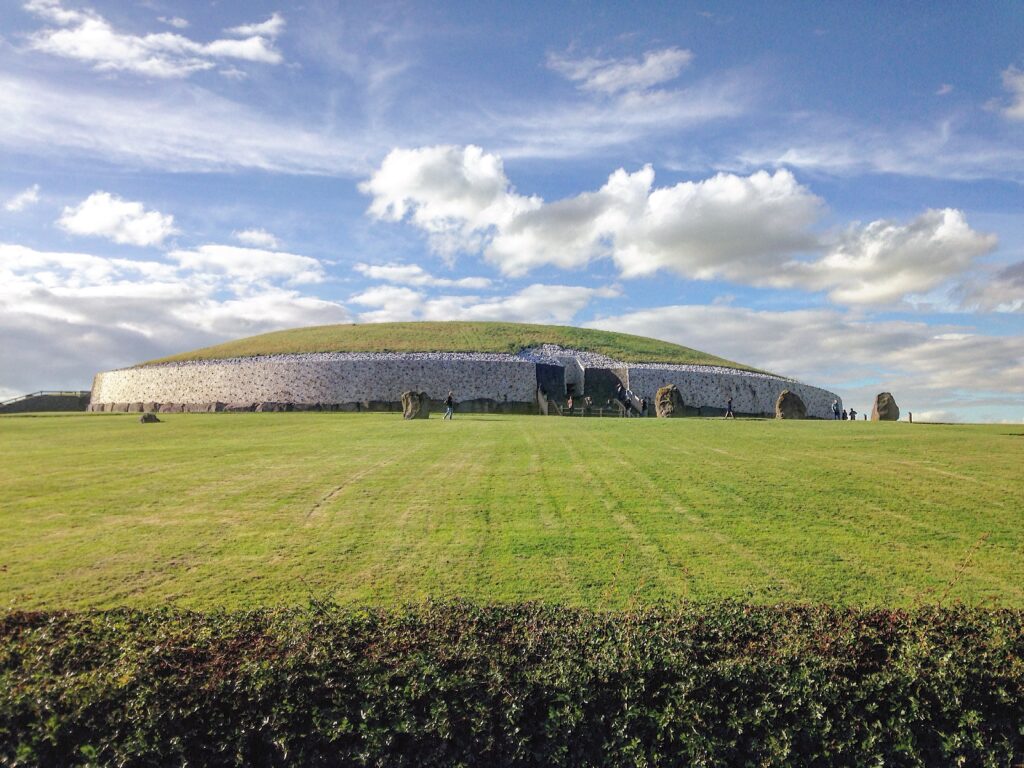
Newgrange sits in the Boyne Valley of County Meath, about 30 miles north of Dublin. It’s a passage tomb built around 3200 BC — which makes it older than Stonehenge, older than the Egyptian pyramids, and one of the most significant prehistoric monuments in Europe. The structure is massive: a kidney-shaped mound covering more than an acre, ringed by 97 kerbstones, many carved with Neolithic art.
But Newgrange isn’t just old. It’s an engineering marvel. Once a year, on the winter solstice, sunlight penetrates the narrow passage and illuminates the inner chamber for exactly 17 minutes. The alignment is so precise that it’s hard to believe it was achieved 5,000 years ago.
Here’s how to visit, what to expect, and how to make the most of your time there.
Book Your Tour in Advance
You can’t simply walk up to Newgrange. All visits are guided, and access is controlled through the Brú na Bóinne Visitor Centre in Donore, about two miles from the monument itself. You’ll watch a short film, then board a shuttle bus to the site. Tours run year-round, but they sell out — especially in summer and around the solstice.
Book online at least a few days ahead, ideally longer if you’re visiting in June, July, or August. Tours last about an hour and include entry to the passage tomb itself. Group sizes are capped at 25, so it never feels overcrowded inside the chamber.
If you’re staying in Dublin and don’t want to drive, Viator offers half-day and full-day tours that handle transport and entry. Most include a stop at the Hill of Tara as well.
What You’ll See Inside
The exterior alone is striking. The front of Newgrange was reconstructed in the 1970s using white quartz stones found during excavation, and while some archaeologists debate the accuracy, the effect is dramatic: a gleaming facade that would have been visible for miles in ancient times.
The entrance stone is one of the finest examples of Neolithic art in Europe, covered in spirals, lozenges, and concentric circles. No one knows exactly what they mean, but the craftsmanship is extraordinary.
Inside, you’ll walk a 60-foot passage into the central chamber. The ceiling is corbelled — each stone layer slightly overhanging the one below — and it’s remained watertight for five millennia. Three recesses branch off the main room, and large stone basins (likely used for cremated remains) sit in two of them.
Your guide will turn off the lights and simulate the solstice sunrise using a lamp. It’s a brief moment, but the effect is powerful: a shaft of light illuminating the dark chamber, just as it has since the Stone Age.
The Winter Solstice Lottery
Experiencing the real solstice event — around December 21 each year — is nearly impossible unless you win the lottery. Every fall, Brú na Bóinne holds a drawing for 50 spots (plus a guest each) to be inside the chamber on one of the five mornings around the solstice. Entries are free, and tens of thousands of people apply.
Even if you win, there’s no guarantee: Irish weather in December is famously unpredictable, and clouds often obscure the sunrise entirely. But if the conditions align, you’ll witness something almost no one else will.
Knowth and Dowth
Newgrange is part of a larger complex. Knowth, just a mile east, is another passage tomb — actually larger than Newgrange, with two passages and more than 200 decorated stones. It’s less famous but equally impressive, and you can visit it on a combined ticket.
Dowth, the third major tomb in the Brú na Bóinne complex, is currently closed for conservation work, though you can view it from the outside along the Boyne Valley Drive.
If you have time, visit both Newgrange and Knowth. The combined tour takes about three hours, and you’ll leave with a much deeper sense of the scale and sophistication of Neolithic Ireland.
Practical Tips
Newgrange is a 45-minute drive from Dublin via the M1 and local roads. Parking at the visitor center is free. If you’re relying on public transport, it’s tricky — buses from Dublin to Drogheda run regularly, but you’ll need a taxi from there to the site.
Wear comfortable shoes. The ground around the mound can be uneven, and the passage inside is narrow with a low ceiling. If you’re claustrophobic or have mobility issues, ask your guide before entering.
Photography is allowed outside but not inside the chamber. The site is exposed, so bring a jacket even in summer — wind is common in the Boyne Valley.
Standard tours cost around $15 per adult. Combined Newgrange and Knowth tickets are closer to $20. Prices are subject to change, so check the official Brú na Bóinne website before you go.
Why It Matters
Newgrange isn’t just a tomb. It’s evidence of a society with resources, knowledge, and a relationship to the cosmos that we’re still trying to understand. The people who built it had no written language, no metal tools, and no wheel — yet they created something that has outlasted empires.
Standing inside that chamber, you feel the weight of all that time. It’s one of the most humbling experiences Ireland offers.
Want more stories like this delivered weekly? Subscribe to The Ultimate Ireland Travel Guide newsletter — one short story a week, straight to your inbox.
Heads up — some links in this article are affiliate links. If you sign up through them, we may earn a small commission at no extra cost to you. We only recommend tools we use ourselves.