
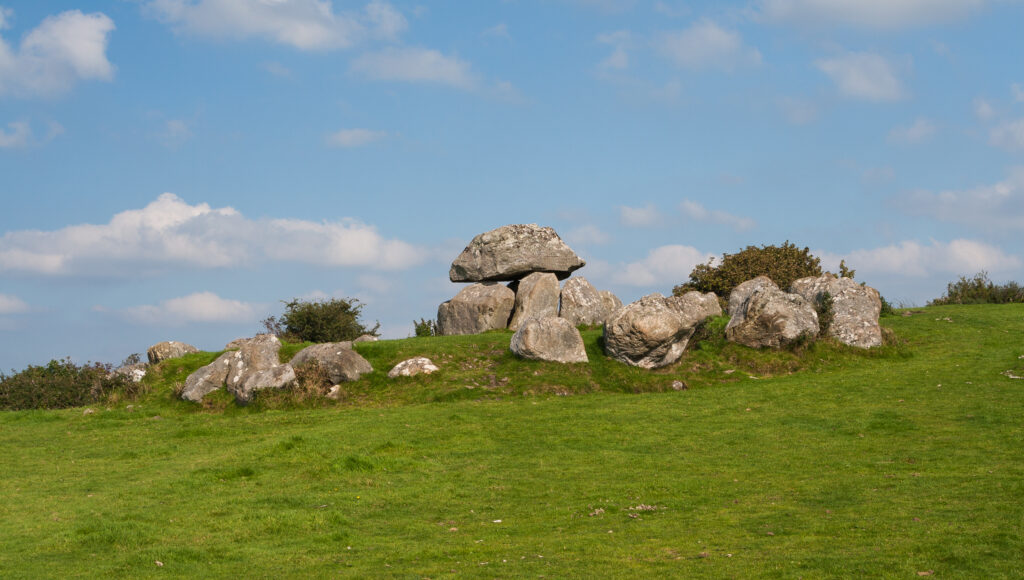
While most travelers know about Newgrange in County Meath, far fewer make it to Carrowmore in County Sligo—and that’s their loss. This sprawling megalithic cemetery holds more than 60 passage tombs, stone circles, and dolmens dating back over 5,500 years. It’s older than Newgrange, older than Stonehenge, and on most days, you’ll have the place nearly to yourself.
The site sits in gentle farmland just outside Sligo town, with Knocknarea mountain looming to the west. You can walk among the tombs, touch the stones, and feel the weight of millennia without fighting through tour groups. It’s one of Ireland’s most accessible ancient sites, and one of the most atmospheric.
What You’ll See at Carrowmore
The visitor center sits at the entrance and offers context before you explore. A short film explains the archaeology, and displays show artifacts found on-site, including cremated bone, pottery, and stone tools. From there, you’ll walk a looped trail through the fields.
The most intact monument is Tomb 51, a large dolmen with a massive capstone balanced on upright slabs. It’s the centerpiece of the site and shows the engineering skill of Neolithic builders. Other tombs are more fragmentary—rings of boulders surrounding central chambers, some still capped, others open to the sky.
Most of the tombs align with Knocknarea, the flat-topped mountain visible from nearly every point in the cemetery. On its summit sits a huge cairn believed to be the tomb of Queen Maeve, a legendary figure from Irish mythology. The connection between Carrowmore and Knocknarea suggests this was a ritual landscape, not just a burial ground.
The trail is flat, graveled, and takes about 45 minutes at a leisurely pace. Interpretive signs mark key tombs and explain their construction. You’re free to walk up to the stones—unlike at Newgrange, there are no ropes or barriers.
How to Get There and When to Visit
Carrowmore is located about 3 miles southwest of Sligo town, just off the R292 road toward Strandhill. If you’re driving, follow signs from Sligo; parking is free at the visitor center. The site is also reachable by bike—Sligo is flat and bike-friendly, and the route takes you through quiet country lanes.
The visitor center is open daily from April through October, typically 10:00 a.m. to 6:00 p.m., with shorter hours in shoulder months. Admission is around $5 USD for adults, with discounts for seniors and students. Kids under 12 are free. From November through March, the site is closed, though you can still walk the exterior fields where some tombs are visible.
Early morning and late afternoon offer the best light for photography, especially in summer when the sun sets behind Knocknarea. Midweek visits are quieter than weekends. The site is exposed to wind, so bring a jacket even in warm weather.
Combining Carrowmore with Knocknarea and Strandhill
Carrowmore pairs perfectly with a hike up Knocknarea. The trailhead is about 10 minutes’ drive from the megalithic cemetery, and the summit hike takes roughly an hour each way. The cairn at the top—40 feet high and 600 feet across—has never been excavated, and legend says disturbing it brings bad luck. The views stretch across Sligo Bay, Benbulben, and the Atlantic.
After your hike, head to Strandhill, a surf village on the coast. It’s a 5-minute drive from Knocknarea and has several good cafés and pubs. The Strand Bar serves excellent seafood chowder, and Mammy Johnston’s Ice Cream Parlour is a local favorite. If you’re visiting in summer, you can watch surfers tackle the Atlantic swells from the beach.
This trio—Carrowmore, Knocknarea, and Strandhill—makes for a superb half-day or full-day loop from Sligo town. You’ll cover ancient history, mountain scenery, and coastal culture without driving more than a few miles.
Why Carrowmore Matters
Carrowmore is significant not just for its age, but for its scale. It’s the largest Stone Age cemetery in Ireland, and one of the largest in Europe. Excavations have revealed that the tombs were used over centuries, with cremated remains placed in the central chambers and the surrounding stones serving as markers and gathering spaces.
The site also challenges assumptions about Neolithic Ireland. For years, Newgrange was considered the pinnacle of passage tomb construction. But radiocarbon dating at Carrowmore suggests that some of these simpler tombs predate Newgrange by several hundred years. That means the people here were building monumental stone structures before the great passage tombs of the Boyne Valley.
Walking among the stones, you’re stepping into a landscape that was sacred long before Christianity, long before the Celts, long before metal or writing. It’s humbling, and it’s quiet in a way few Irish heritage sites manage to be.
If you’re planning a trip through the northwest, make time for Carrowmore. It’s not as famous as the Cliffs of Moher or the Giant’s Causeway, but it’s every bit as powerful—and far more intimate.
Want more stories like this delivered to your inbox? Subscribe to The Ultimate Ireland Travel Guide newsletter and get one short story a day—no fluff, just the Ireland beyond the guidebooks.