
Driving in Ireland opens up the country in ways public transport can’t match. You’ll reach hidden beaches, mountain passes, and villages that buses skip entirely. But if you’ve never driven on the left side of the road, the prospect can feel daunting.
The truth? Most travelers adapt within a day or two. Irish roads demand attention, but they’re not impossible. Here’s what you need to know before you pick up the keys.
What’s Different (and What’s Not)
The driver sits on the right side of the car. You drive on the left side of the road. The gear shift (if you rent a manual) is on your left, operated with your left hand. Turn signals and wipers are reversed from American cars, so expect to accidentally trigger the wipers a few times when you mean to signal.
Roundabouts are everywhere, and you enter them clockwise, yielding to traffic from the right. Speed limits are in kilometers per hour: 50 km/h in towns, 80-100 km/h on regional roads, and 120 km/h on motorways. Road signs use kilometers, not miles.
What stays the same: the brake and accelerator are in the same positions. Your right foot does the same job it always has.
The Real Challenges: Narrow Roads and Stone Walls
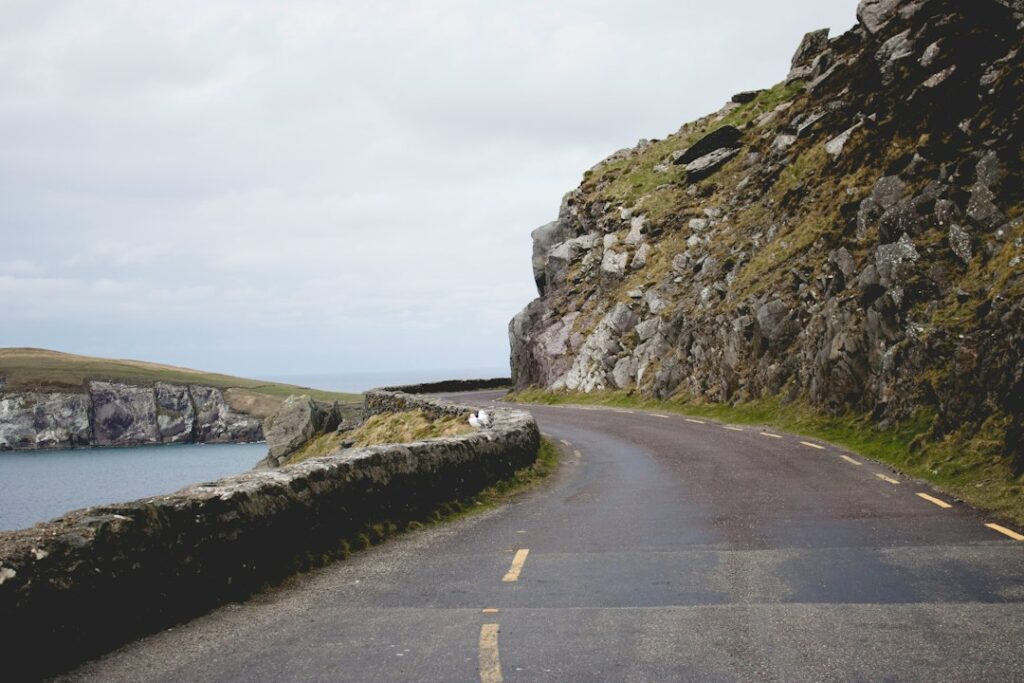
Ireland’s secondary and rural roads are tight. On many routes in Connemara, Donegal, or the Dingle Peninsula, two cars can barely pass. You’ll pull into passing places, reverse around blind corners, and squeeze past stone walls with inches to spare.
Hedgerows line countless lanes, blocking sightlines. Tractors, sheep, and tour buses appear without warning. Locals drive these roads fast because they know every turn. You shouldn’t.
Single-track roads with grass growing down the center are common in the west and northwest. When you meet an oncoming car, one of you reverses to the nearest wide spot. Locals are patient about this. Take your time.
Rental cars pick up scratches and scrapes. Pay for the full insurance coverage. It’s worth it.
Renting a Car: What to Book and Where
Book an automatic if you’re not confident with a manual transmission. Driving on the left while operating a stick shift with your weaker hand adds unnecessary difficulty, especially on hill starts in places like Killarney or the Wicklow Mountains.
Compact cars are easier to maneuver on narrow roads. A small hatchback will fit where a mid-size sedan won’t. If you’re touring the Wild Atlantic Way or heading into rural counties, smaller is smarter.
Pick up your car at the airport if you’re flying into Dublin, Shannon, or Cork. Viator offers packages that combine car rental with guided tour options if you’d rather ease into driving gradually. Most rental counters are located in the terminal or a short shuttle ride away.
Expect to pay between $30 and $70 per day depending on the season, car size, and how far ahead you book. Add another $15 to $25 per day for comprehensive insurance. Check your credit card benefits—some cover rental car insurance abroad, though Ireland’s narrow roads make the extra coverage a safer bet.
Your First Drive: Tips That Actually Help
Before leaving the rental lot, sit in the car for a few minutes. Adjust the mirrors, locate the lights and wipers, and take a slow lap around the parking area to get the feel of the width and turning radius.
Your first hour will be the hardest. Start on a weekday morning if possible, when traffic is lighter. Avoid driving straight into Dublin, Cork, or Galway city centers. If you must pick up a car in Dublin, head west or south toward quieter roads as quickly as you can.
Use the center line and the left curb as reference points. Stay aware of where your left front corner is—it’s the part most likely to scrape a wall or hedge. On narrow roads, slow down well before turns. Irish roads don’t give you much margin for error.
Roundabouts feel backward at first. Remember: look right, yield to traffic coming from the right, and enter when it’s clear. Stay in the left lane unless you’re exiting further around. Signal left when you’re ready to exit.
GPS helps, but don’t trust it blindly. Some mapping apps route you down roads barely wide enough for a bicycle. If a road looks impossibly narrow on the screen, it probably is. Have a paper map as backup and don’t be afraid to turn around.
When Not to Drive
If you’re spending most of your time in Dublin, don’t rent a car for the city. Parking is expensive, traffic is heavy, and public transport and walking cover the capital well. Rent a car only for day trips or when you leave the city.
Similarly, if your itinerary is limited to a few major towns connected by bus or train—Galway, Cork, Kilkenny—you might not need to drive at all. But if you want to explore the Beara Peninsula, drive the Sky Road in Connemara, or stop at every coastal viewpoint on the Causeway Coastal Route, a car is essential.
Driving in Ireland is one of the best ways to see the country on your own terms. The first few hours might feel awkward, but once you settle in, the freedom is unbeatable.
Want more practical advice, hidden routes, and daily stories from around Ireland? Subscribe to The Ultimate Ireland Travel Guide newsletter—one short story a day, straight to your inbox.
Heads up — some links in this article are affiliate links. If you sign up through them, we may earn a small commission at no extra cost to you. We only recommend tools we use ourselves.