
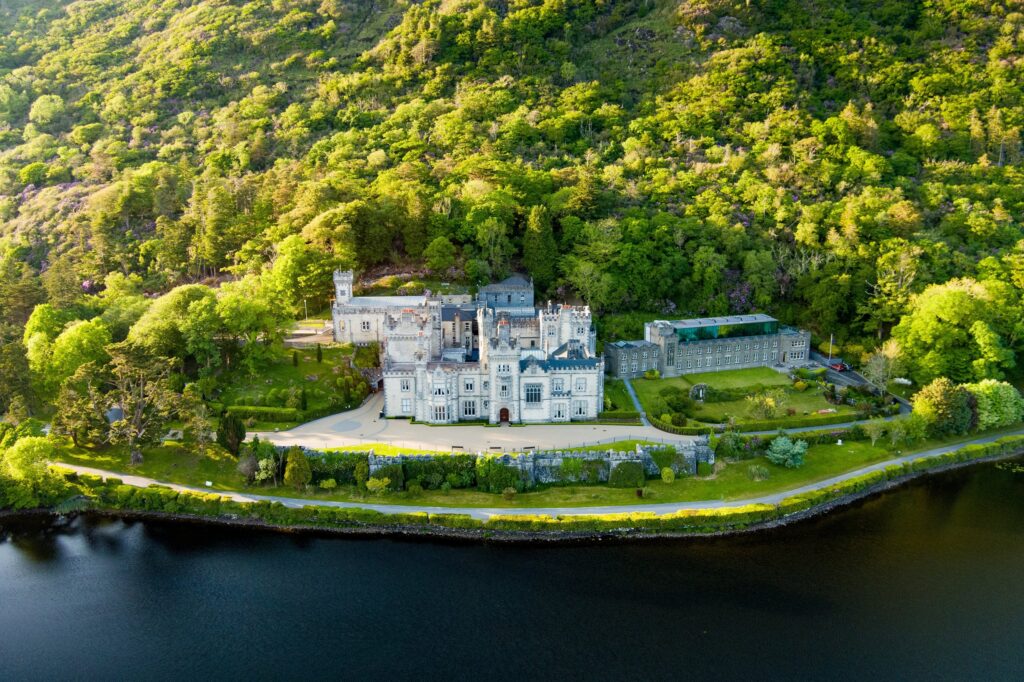
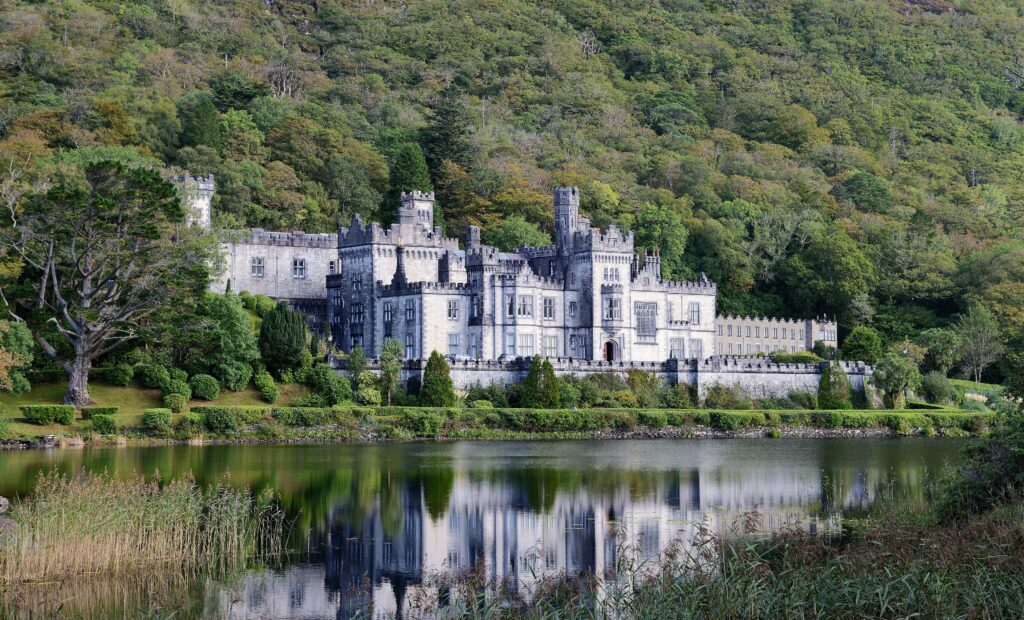
Kylemore Abbey sits at the edge of a glacial lake, its turrets and towers reflected in still water beneath the Twelve Bens mountain range. Built in 1868 as a romantic gift from Mitchell Henry to his wife Margaret, the neo-Gothic castle became a Benedictine abbey in 1920 and remains home to a small community of nuns today. The estate is one of Connemara‘s marquee stops, and it deserves more than a quick photo from the car park.
Most visitors spend an hour here. Plan for three if you want to see the abbey rooms, walk to the Gothic church, explore the Victorian walled garden, and take in the lakeside trails without feeling hurried.
Getting to Kylemore Abbey
Kylemore is located on the N59, roughly halfway between Clifden and Leenaun in County Galway. From Galway city, it’s about 50 miles west—just over an hour by car through Oughterard and Maam Cross. If you’re driving the Connemara loop, Kylemore makes a natural midpoint stop between Clifden and Westport or the scenic route south to Leenaun and Killary Harbour.
There’s a large car park on site, and the estate is well signposted. Bus Éireann’s route 419 from Galway to Clifden stops at Kylemore, but schedules are limited—check times in advance if you’re relying on public transport. Most visitors arrive by rental car or on guided day tours from Galway.
Admission is around $18 USD for adults. The ticket includes access to the abbey’s ground-floor rooms, the walled garden (accessed via a free shuttle bus), the Gothic church, and the lakeshore walking trails. The abbey is open daily year-round, though hours vary by season—check ahead in winter.
What to See Inside the Abbey
The self-guided tour takes you through the abbey’s ground-floor rooms, including the grand entrance hall, dining room, library, and drawing room. Many of the interiors retain their Victorian Gothic character, with oak paneling, stained glass, and ornate fireplaces. Interpretive panels tell the story of Mitchell Henry, a wealthy doctor and politician who built the estate, and the Benedictine community that has called it home for over a century.
There’s also a small exhibition on the abbey’s history, from its days as a private residence through its transformation into a girls’ boarding school run by the nuns. The upstairs remains the private residence of the Benedictine community and is not open to visitors.
Don’t skip the Gothic church, a ten-minute walk along the lakeshore path. Henry built it as a memorial to his wife, who died suddenly during a trip to Egypt. The tiny chapel, set in a quiet clearing beneath the mountain, is one of the most atmospheric spots on the estate.
The Victorian Walled Garden
The six-acre walled garden is a twenty-minute walk from the abbey—or a quick ride on the free shuttle bus that runs continuously throughout the day. Built in the 1860s, the garden once supplied the estate with vegetables, fruit, and flowers. After decades of neglect, it was restored by the Benedictine community and reopened in 2000.
Today it’s a working garden again, with glasshouses, herbaceous borders, vegetable plots, and a stream running through the center. The head gardener and a small team maintain it using traditional Victorian methods. In summer, the borders are thick with roses, delphiniums, and foxgloves. In early autumn, the kitchen garden is heavy with apples, rhubarb, and kale.
There’s a small café in the garden serving tea, scones, and soup made with produce grown on site. It’s a quieter spot for a break than the main tearoom near the abbey entrance.
Trails, Timing, and Practical Tips
Several short trails loop around the estate. The lakeside path to the Gothic church is the easiest and most scenic—flat, well-maintained, and suitable for most fitness levels. A longer woodland trail climbs gently into the hills behind the abbey, offering views over Pollacapall Lough and the Twelve Bens. Allow 45 minutes to an hour for the loop.
The estate is busiest between 11 a.m. and 2 p.m., especially in summer and on weekends. Arrive early or late in the day for smaller crowds and better light for photography. The view from the lakeshore path, with the abbey framed by mountains, is iconic—and most dramatic in the soft morning or evening light.
Wear layers. Connemara’s weather shifts quickly, and even in summer you’ll want a windproof jacket. The garden and church walks are exposed, and it’s often cooler near the water.
The tearoom near the entrance serves lunch, sandwiches, and cakes, and there’s a small craft shop selling local goods, books, and Benedictine pottery made by the nuns. If you’re continuing west toward Clifden, stop at Letterfrack, a tiny village two miles down the road, for a pint or a bowl of seafood chowder at one of the pubs.
Want more stories like this delivered to your inbox? Subscribe to The Ultimate Ireland Travel Guide newsletter—one short story a day, Ireland beyond the guidebooks.