
Renting a car is the best way to explore Ireland beyond the cities. It unlocks the remote peninsulas, coastal routes, ancient sites, and villages that public transport doesn’t reach. But if you’re coming from a country that drives on the right, the idea of steering from the passenger side on narrow Irish roads can feel daunting.
It’s manageable. Thousands of visitors do it every year. With the right preparation and a few days of practice, you’ll be navigating roundabouts and country lanes with confidence.
Renting a Car in Ireland
Most international car rental companies operate at Dublin, Shannon, Cork, and Belfast airports. Book in advance for the best rates—expect to pay anywhere from $30 to $80 per day depending on vehicle size, season, and how far ahead you reserve. Summer and bank holiday weekends command higher prices.
You’ll need a valid driver’s license from your home country (held for at least two years) and a credit card in the driver’s name for the deposit. If you’re under 25 or over 70, expect surcharges or restrictions. Most rentals include basic third-party insurance, but you’ll be offered additional collision damage waiver (CDW) coverage. Read the terms carefully—excess fees can run into the thousands of dollars if you decline extra coverage and damage the car.
Choose the smallest car you can comfortably fit your luggage into. Irish roads—especially in rural areas—are far narrower than most North American highways. A compact or economy car will save you stress, fuel costs, and the occasional scrape against a stone wall.
Pick up your car at the airport if you’re flying in, but don’t collect it on your first day if you’re starting in Dublin, Galway, or Cork. City driving is the hardest place to learn. Spend a night in town, then pick up your rental the morning you’re ready to head into the countryside.
Driving on the Left: What to Expect
The most disorienting part isn’t the side of the road—it’s sitting on the right side of the car. Your instinct will be to drift toward the center line because your spatial reference has flipped. The trick is to keep your body (the driver’s seat) near the middle of the road, not the edge.
Roundabouts are everywhere, and you’ll enter them clockwise. Yield to traffic coming from your right, signal left when exiting, and don’t panic if you miss your exit—just go around again. Start cautiously, and within a day or two it’ll feel automatic.
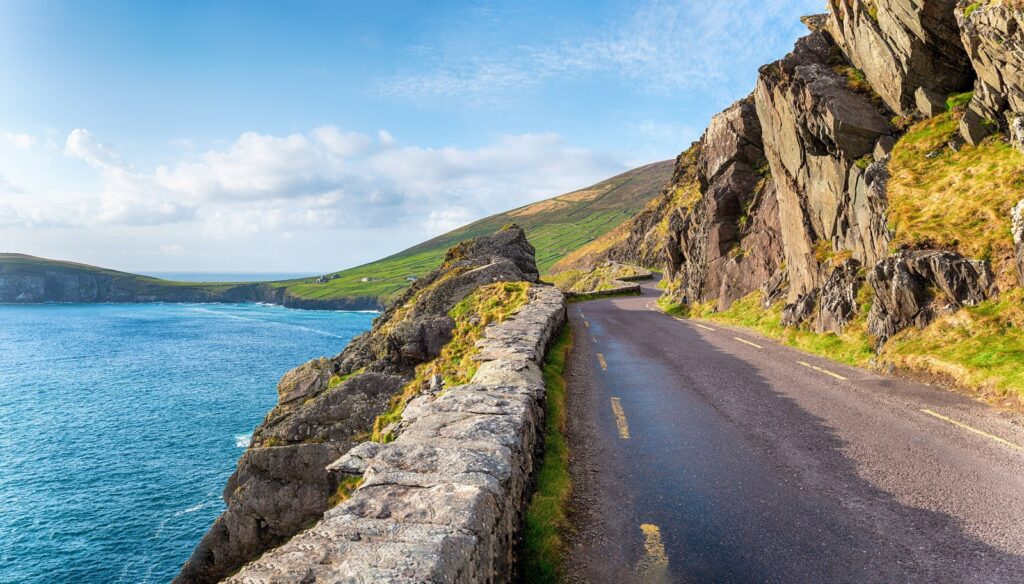
Irish roads are classified as M (motorway), N (national), and R (regional), with L (local) roads being the smallest. Motorways are wide, fast, and easy. N-roads are generally two lanes and well-maintained. R and L roads are where it gets interesting: tight, winding, bordered by hedgerows or stone walls, and often barely wide enough for two cars. Passing places exist, but you’ll need to pull in when meeting oncoming traffic. Drive slowly, stay alert, and don’t be shy about reversing to a wider spot if needed.
Speed limits are posted in kilometers per hour: 50 km/h in towns, 80 km/h on regional roads, 100 km/h on national roads, and 120 km/h on motorways. In Northern Ireland, signs are in miles per hour.
Practical Tips for Your First Few Days
Give yourself time. Don’t plan a four-hour drive on your first day behind the wheel. A short 45-minute trip from the airport to somewhere like Trim, Kilkenny, or the Wicklow Mountains is plenty while you’re adjusting.
Use a GPS or smartphone mount, but download offline maps in case you lose signal in remote areas. Google Maps works well, but be cautious with estimated drive times—narrow roads and slower speeds mean journeys take longer than the app suggests.
Fill up your tank in towns. Rural gas stations can be few and far between, especially in Connemara, Donegal, and the peninsulas of Kerry and Cork. Fuel is sold by the liter and costs roughly $6 to $7 per gallon equivalent.
Parking in villages and small towns is usually free or inexpensive, but cities like Dublin, Galway, and Killarney have paid lots and strict enforcement. Use park-and-ride facilities on the outskirts if you’re staying overnight.
Watch for sheep, cattle, and tractors on rural roads. Livestock has right of way, and farmers moving herds will block the road entirely. Just stop, wait, and enjoy the show.
Is It Worth It?
Absolutely. A rental car gives you the freedom to chase coastal sunsets on the Wild Atlantic Way, pull over at unmarked megalithic tombs, take spontaneous detours down narrow boreens, and discover tucked-away pubs where locals still play traditional music on weeknights.
The first few hours might feel awkward, but by day two you’ll wonder why you were nervous. Ireland’s beauty unfolds slowly, away from the tour bus stops, and having your own wheels is the best way to find it.
Want more insider tips, hidden routes, and daily stories from around Ireland? Subscribe to The Ultimate Ireland Travel Guide newsletter—one short story a day, straight to your inbox.