
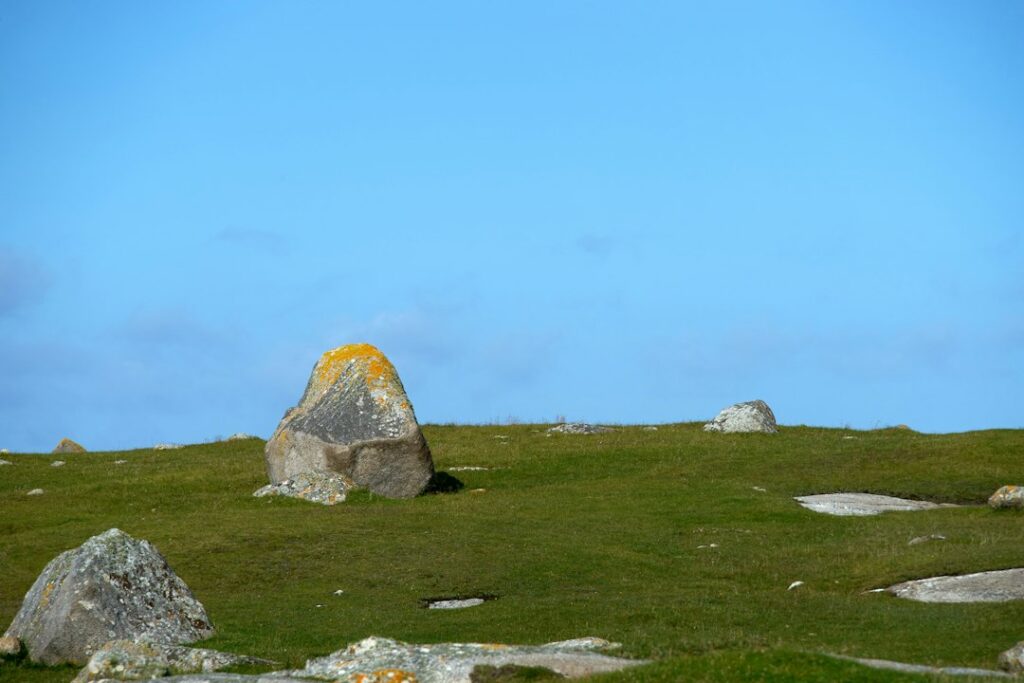
The Burren doesn’t look like the rest of Ireland. Instead of green fields and rolling hills, you’ll find a vast moonscape of fractured grey limestone stretching across 250 square kilometers of north County Clare. The name comes from the Irish Boíreann, meaning “rocky place,” and it’s an understatement. This is one of Europe’s most distinctive karst landscapes, where rare Arctic and Mediterranean plants somehow thrive in the same cracks, and where 5,000-year-old tombs sit atop windswept plateaus.
The Burren rewards slow exploration. You can drive through in an hour, but you’ll miss everything that makes it extraordinary: the hidden turloughs that appear and vanish with the seasons, the perfumed hawthorn scrub sheltering in the grykes, the portal tombs perched on hilltops with views to Galway Bay.
Where to Start: The Burren Centre and Kilfenora
Begin at the Burren Centre in Kilfenora, a small village at the heart of the region. The exhibition gives context you’ll need to understand what you’re seeing outside: how the limestone formed 350 million years ago on a tropical seabed, how glaciers carved and scoured it, how rainfall created the fissured pavement. Admission runs around $8. The center is open daily from March through October, with reduced winter hours.
Kilfenora’s 12th-century cathedral, a short walk away, holds some of Ireland’s finest high crosses. The Doorty Cross, still standing in the churchyard, shows intricate Celtic patterns barely weathered after 800 years.
The Poulnabrone Dolmen and Ancient Sites
The Burren’s most photographed landmark sits 8 kilometers south of Ballyvaughan on the R480. Poulnabrone portal tomb—a massive capstone balanced on two upright slabs—has stood here for 5,800 years. Excavations in the 1980s found the remains of 33 people buried beneath it, along with pottery and stone tools.
There’s a small parking area (free) and a gravel path to the tomb. Go early morning or late afternoon to avoid tour buses. The site is always open, but respect the barrier ropes—the stone is more fragile than it looks.
Dozens of other tombs, ring forts, and stone cashels dot the Burren, many unmarked on standard maps. Caherconnell Stone Fort, a restored Iron Age ring fort near Poulnabrone, offers guided tours ($10) and sheepdog demonstrations that actually explain traditional farming methods rather than just performing tricks.
Walking the Burren: Trails and Wildflowers
The Burren Way, a 123-kilometer waymarked trail, traverses the entire region from Ballyvaughan to Lahinch, but you don’t need to hike the whole route. The section from Ballyvaughan to Doolin (around 35 kilometers) passes through classic Burren terrain with coastal views.
For shorter walks, the green road from Fanore to Ballyvaughan follows an old drove road across open limestone. Park at the Fanore trailhead and walk as far as you like—even 2 kilometers in gives you the landscape without the commitment. Wear sturdy boots; the limestone can be slippery and ankle-turning sharp.
Late May through early June is wildflower season, when the normally grey landscape erupts with gentians, orchids, and mountain avens. The bizarre microclimate—the limestone absorbs heat and the fissures create sheltered growing spaces—means Arctic-alpine and Mediterranean species grow side by side, something botanists still find remarkable.
Scenic Drives and Getting Around
The most scenic drive runs along the coast from Ballyvaughan south on the R477 (part of the Wild Atlantic Way) to Doolin, then inland on narrow roads toward Kilfenora. This route passes cliffs, terraced limestone slopes, and tiny villages where stone walls are built without mortar, held together by nothing but gravity and skill.
The Corkscrew Hill road between Ballyvaughan and Lisdoonvarna offers spectacular views—and spectacular gradients. There’s a viewing area at the top where the entire Burren spreads out below you, Galway Bay glittering in the distance.
You’ll need a car to explore properly. Roads are narrow and winding; allow more time than Google Maps suggests. Parking at most sites is informal—pull off where others have, and don’t block gates.
Practical Tips for Visiting
Base yourself in Ballyvaughan, Doolin, or Lisdoonvarna. All three have good pubs and guesthouses. Ballyvaughan is quieter; Doolin gets crowded in summer but has the best traditional music scene.
Bring layers. The Burren is exposed, and weather changes fast. What starts as a sunny morning can turn to wind and drizzle by afternoon. Rain gear and windproof jackets are essential.
There are almost no facilities once you leave the villages—no bathrooms, no cafés, no water fountains. Fill up your water bottle and use the restroom before you head out.
If you’re interested in guided walks, the Burren runs several excellent programs. Local guides know where to find the rarest flowers, the hidden fulachta fiadh (Bronze Age cooking sites), and the stories behind the landscape. Viator offers half-day and full-day guided tours that include transportation from Galway or Doolin.
Avoid visiting only the highlights. The Burren reveals itself slowly, in the small details: a hare frozen against grey stone, the smell of wild thyme crushed underfoot, the way light moves across the pavement at dusk. Give it time.
Want more of Ireland’s hidden corners and insider travel tips delivered to your inbox? Subscribe to The Ultimate Ireland Travel Guide newsletter—one short story a day about the Ireland beyond the guidebooks.
Heads up — some links in this article are affiliate links. If you sign up through them, we may earn a small commission at no extra cost to you. We only recommend tools we use ourselves.