
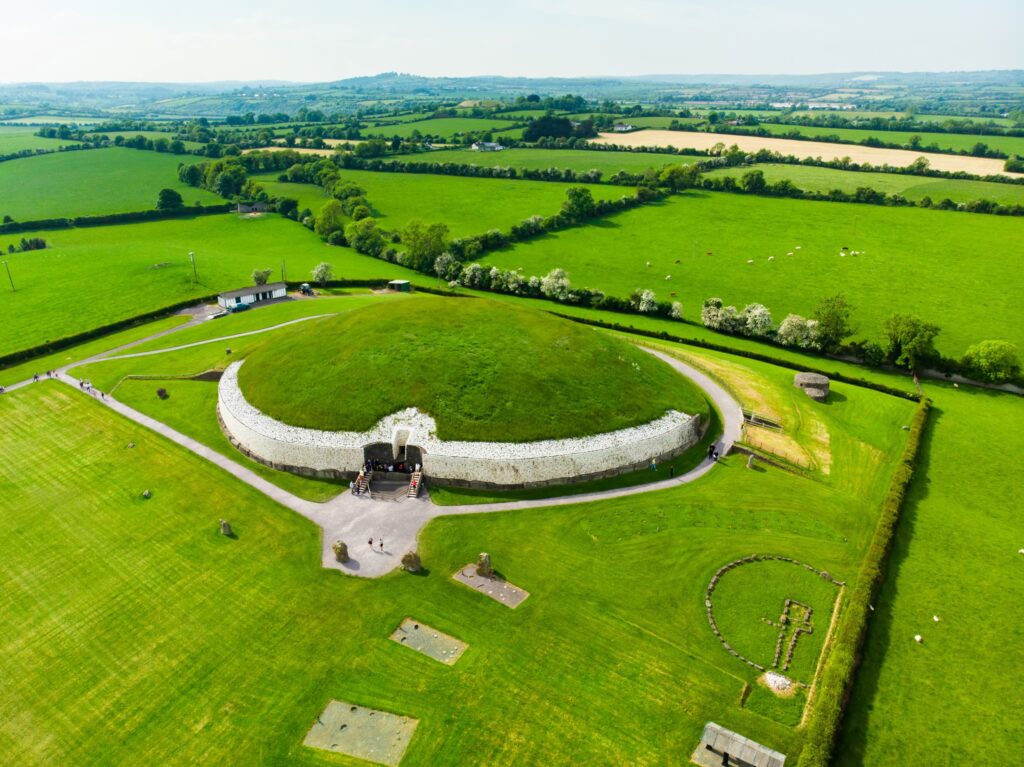
The Hill of Tara rises gently from the farmland of County Meath, 25 miles northwest of Dublin. For more than 1,500 years, this grassy hilltop was the ceremonial and political heart of ancient Ireland—the seat of the High Kings, a place of coronation, assembly, and burial. Today, it’s one of Ireland’s most important archaeological landscapes, with earthworks, standing stones, and passage tombs dating back 5,000 years.
What makes Tara special isn’t grandeur—there are no castle walls or soaring ruins. It’s the weight of history in the landscape itself, the view across five counties, and the realization that you’re standing where Ireland’s mythology and archaeology meet.
What You’ll See at Tara
The Hill of Tara is a complex of monuments spread across a hilltop roughly half a mile long. Most of what you see are earthen mounds and circular embankments, subtle in the landscape but profound in meaning.
The Mound of the Hostages is the oldest structure here, a passage tomb built around 3,000 BC—older than the pyramids. You can’t enter, but its entrance stone is carved with Neolithic art. The Lia Fáil, the Stone of Destiny, stands on the Royal Seat, a circular enclosure where High Kings were said to be crowned. According to legend, the stone would roar when touched by the rightful king.
The Rath of the Synods is a large ceremonial enclosure near the church. St. Patrick is said to have lit the Paschal fire here in defiance of the pagan king Laoghaire in 433 AD, a pivotal moment in Ireland’s Christianization. The Banquet Hall, two long earthen banks running downhill, may have been a ceremonial avenue rather than a feasting space.
From the summit, the view sweeps across the plains of Meath to the Wicklow Mountains in the south and the hills of Cavan to the north. On a clear day, you can see five counties. It’s easy to understand why this place was chosen as a seat of power.
How to Visit
The Hill of Tara is located just outside the village of Tara, off the M3 motorway between Dublin and Navan. There’s a small car park at the site entrance. Admission to the hill itself is free and open year-round—it’s an outdoor archaeological site with no gates or set hours.
The Tara Visitor Centre, housed in the old Church of Ireland church on the hilltop, is open daily from May through September and offers a short audiovisual presentation that contextualizes what you’re seeing. Admission is around $5. From October through April, the center is closed, but the site remains accessible.
Plan to spend 60 to 90 minutes here. Wear sturdy shoes—the ground can be uneven and muddy, especially after rain. There are interpretive panels throughout the site, but the landscape is understated; a little background reading or the visitor center film helps bring it to life.
If you’re driving from Dublin, Tara makes an excellent pairing with nearby Trim Castle (Ireland’s largest Anglo-Norman fortress) or the Brú na Bóinne monuments at Newgrange and Knowth, about 20 minutes northeast.
Why Tara Matters
Tara’s importance isn’t just archaeological—it’s woven into Irish identity. Medieval texts describe it as the capital of the High Kings, the place where Ireland’s provincial rulers gathered for the Féis Temro, or Feast of Tara. The Annals of the Four Masters and the Book of Invasions are filled with stories set here: battles, coronations, divine interventions.
By the 6th century, Tara’s political power had waned, but its symbolic resonance endured. Daniel O’Connell held a massive rally here in 1843, drawing hundreds of thousands in support of Irish self-governance. The hill has remained a potent symbol ever since—not as a monument to any one king or era, but as a site that holds the long memory of Ireland itself.
Visiting Tara is a quiet experience. You won’t find crowds or gift shops. What you will find is space to walk, to think, and to stand in a place where myth, history, and landscape converge in a way that feels uniquely Irish.
Practical Tips
The best time to visit is early morning or late afternoon, when the light is soft and the site is less busy. Spring and autumn are ideal—the grass is green, the weather is mild, and you’ll often have the hilltop to yourself.
There are no facilities on-site beyond the visitor center, so bring water and snacks if you plan to linger. The nearby village of Tara has a small café and pub. If you’re staying in Dublin, Tara is an easy half-day trip by car; it’s harder to reach by public transport, though some Viator tours from Dublin include Tara alongside the Boyne Valley sites.
If you’re interested in Ireland’s ancient past, pair Tara with a visit to Newgrange or the Hill of Slane, where St. Patrick is said to have lit his famous fire. Together, they tell the story of pre-Christian and early Christian Ireland in a landscape that has changed remarkably little.
Want more stories like this—one a day, straight to your inbox? Subscribe to The Ultimate Ireland Travel Guide newsletter and we’ll send you the Ireland beyond the guidebooks, one short story at a time.
Heads up — some links in this article are affiliate links. If you sign up through them, we may earn a small commission at no extra cost to you. We only recommend tools we use ourselves.