Killarney sits tucked between dark lakes and the highest mountain range in Ireland, drawing visitors since Victorian tourists discovered its dramatic scenery in the 1800s. The town itself is compact and walkable, lined with family-run shops, traditional pubs, and restaurants that fill with locals and travelers year-round. Beyond the colorful storefronts, Killarney National Park spreads across 25,000 acres of woodland, lakeshore, and mountain trails.
Most travelers use Killarney as a base for exploring the Ring of Kerry and Dingle Peninsula, but the town and its surrounding park deserve at least two full days. You’ll find medieval abbeys, Victorian estates, red deer wandering through ancient oak forests, and trails that climb into the MacGillycuddy’s Reeks.
Getting to Killarney and Getting Around
Killarney sits 55 miles west of Cork and 207 miles southwest of Dublin. The train from Dublin takes about three and a half hours, with several departures daily. Buses connect Killarney to Cork, Galway, and other towns along the Wild Atlantic Way.
If you’re driving, the N22 from Cork is the most direct route. Killarney town is small enough to explore on foot, but you’ll want a car or bike to reach the national park’s far corners. Several shops on High Street and New Street rent bikes for around $25 per day. Jaunting cars—traditional horse-drawn carriages—wait near the town center and offer scenic trips through the park, though they’re pricier at $50 to $80 for a tour.
Parking in town can be tight during summer. Use the public lot on Mission Road or Park Road, both within a five-minute walk of the main shopping streets.
What to See in Killarney Town
St. Mary’s Cathedral anchors the town’s southern edge, a Gothic Revival limestone church completed in 1855. It’s open for visitors most afternoons, and the interior features soaring arches and stained glass that catches the afternoon light.
The town center clusters around High Street and Main Street, where you’ll find wool shops selling Aran sweaters, craft stores with locally made pottery, and pubs that have served pints for generations. Stop into Jam on Old Market Lane for excellent coffee and pastries, or Quinlan’s Seafood Bar on High Street for oysters and chowder.
For traditional music, Courtney’s Bar on Plunkett Street hosts sessions most evenings, with local musicians playing fiddle, bodhrán, and tin whistle in the snug back room. The music usually starts around 9:30 p.m.
Exploring Killarney National Park
The national park begins just south of town, accessible by foot, bike, or car. The main entrance sits off Muckross Road (N71), about two miles from the town center. Admission to the park is free.
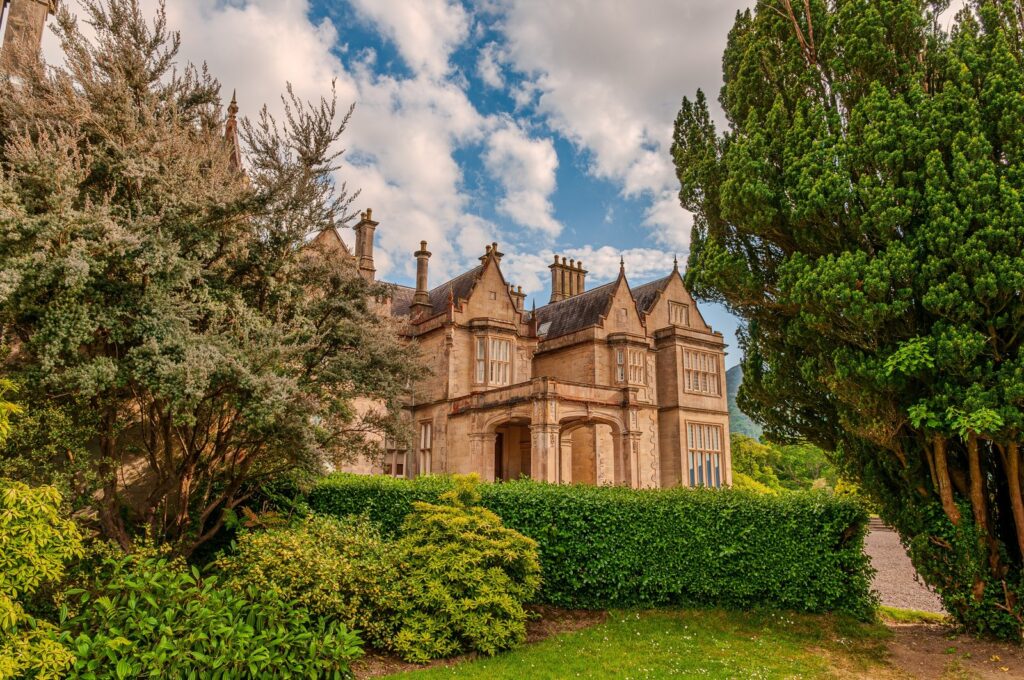
Muckross House and Gardens is the park’s centerpiece, a 19th-century Victorian mansion surrounded by manicured gardens and walking paths. The house operates as a museum showing furnished rooms from the 1800s. Admission costs around $10. The traditional farms behind the house recreate rural Irish life from the early 1900s, with working farmhouses, animals, and costumed guides demonstrating butter-making and turf-cutting.
Ross Castle sits on the shore of Lough Leane, a 15th-century tower house restored and open for guided tours. The views across the lake to the mountains are spectacular, especially in late afternoon. Tours run every half hour and cost about $6.
The park’s trail network includes easy lakeside walks and steep mountain climbs. The Blue Pool Walk is a gentle two-mile loop through oakwood forest to a small waterfall. For something more challenging, the trail to Torc Waterfall climbs through woodland before reaching the 60-foot cascade. From there, you can continue up to Torc Mountain’s summit for views across the lakes.
When to Visit and Practical Tips
Killarney draws crowds from May through September, particularly during July and August when Irish and European families take summer holidays. Book accommodations well in advance if you’re visiting then. Late spring (April and May) and early fall (September and October) offer milder weather, fewer visitors, and lower prices.
Winter is quiet and often rainy, but the town keeps its charm, and you’ll have trails largely to yourself. Many hotels offer discounted rates from November through March.
Pack layers and waterproof gear regardless of season—the weather changes quickly in the mountains. Good walking shoes are essential if you plan to explore the park’s trails.
Viator offers day tours from Killarney that combine the Ring of Kerry, Gap of Dunloe, and other nearby attractions if you prefer guided excursions.
Three or four days in Killarney gives you time to explore the town, hike the national park, and drive the Ring of Kerry or venture to the Dingle Peninsula. The town makes an excellent base for exploring County Kerry’s lakes, mountains, and coastal scenery.
Want more stories about Ireland’s towns, trails, and hidden corners? Subscribe to The Ultimate Ireland Travel Guide newsletter—one short story a day, delivered to your inbox.
Heads up — some links in this article are affiliate links. If you sign up through them, we may earn a small commission at no extra cost to you. We only recommend tools we use ourselves.