
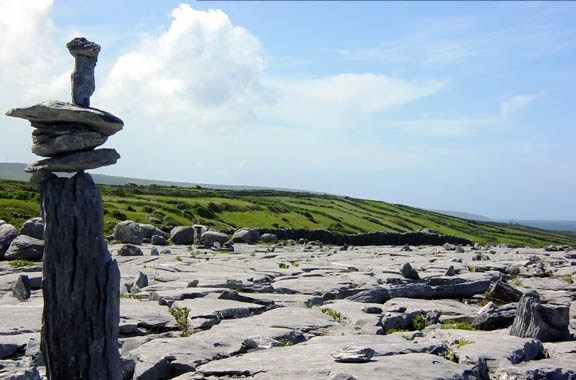
The Burren occupies roughly 100 square miles of northwest County Clare, and it looks like nowhere else in Ireland. This karst limestone landscape — all fractured pavements, disappearing streams, and bare gray rock — earned its name from the Irish Boíreann, meaning “great rock.” One of Cromwell’s surveyors famously complained there wasn’t enough wood to hang a man, nor water to drown him, nor soil to bury him. He missed the point entirely.
What appears barren from a distance reveals itself as one of Europe’s most botanically rich environments. Arctic, Alpine, and Mediterranean plants grow side by side in the grikes — the deep fissures between limestone slabs — creating a wildflower display that peaks from May through August. You’ll find it bordered by Galway Bay to the north, the village of Corofin to the east, and the market town of Ennistymon to the west.
The Landscape and How It Formed
The Burren’s limestone formed 350 million years ago from the shells and skeletons of sea creatures when this area lay beneath a tropical sea. Subsequent ice ages scraped away the soil, exposing the rock and carving the distinctive terraced pavements you see today. Water did the rest, dissolving the limestone to create an underground world of caves, springs, and rivers.
This geology creates a microclimate. The stone absorbs heat during summer days and releases it at night, while the grikes shelter plants from Atlantic winds. Rain vanishes instantly through the porous rock, feeding underground aquifers and emerging as springs at lower elevations.
The best way to understand this landscape is on foot. The Burren Way walking trail runs 71 miles from Lahinch to Corofin, but you don’t need to tackle the whole route. A two-hour walk from Ballyvaughan through Caher Valley shows you classic pavements, hazel scrubland, and distant mountain views. The green road from Fanore to Bell Harbour follows an old drove route across pristine limestone.
Ancient Sites Worth Your Time
Humans have lived here for 6,000 years, and they left their mark. The Poulnabrone Dolmen, a portal tomb dating to 3200 BCE, stands stark against the sky five miles south of Ballyvaughan on the R480. It’s the Burren’s most photographed monument — arrive before 9 a.m. or after 6 p.m. to avoid tour buses.
Caherconnell Stone Fort, a mile south of Poulnabrone, is a remarkably intact ring fort from around 600 CE. The site offers sheepdog demonstrations twice daily in summer (admission $10) and self-guided access to the fort itself. You can walk the walls and understand how these defensive homesteads functioned.
The Burren Perfumery near Carron sits in a pocket of woodland — unusual in this bare landscape. Stop for lunch at their café and browse locally made soaps and fragrances distilled from Burren flowers. It’s a good midpoint break if you’re driving the circuit.
Villages and Practical Details
Ballyvaughan, on the north coast, makes the best base. This harbor village has several good pubs, a handful of B&Bs, and easy access to the heart of the Burren. Monk’s Pub serves excellent seafood chowder — get a seat by the fire if it’s a damp day.
Kilfenora, the “City of the Crosses,” lies on the Burren’s southern edge. Its visitor center (admission $7) provides the geological and historical context you need before exploring. The adjacent ruined cathedral contains fine high crosses from the 12th century.
Lisdoonvarna, famous for its matchmaking festival each September, sits on the western edge. The town’s Victorian spa heritage gives it a faded charm, and it’s well positioned for exploring the Cliffs of Moher, just six miles southwest.
Drive the corkscrew hill road — the R477 — between Ballyvaughan and Lisdoonvarna for panoramic views across the entire plateau. There are several pull-offs where you can stop safely. The best light for photography comes in early morning or late afternoon when the low sun emphasizes the texture of the stone.
When to Visit and What to Bring
May and June bring the wildflower peak — look for spring gentians, bloody cranesbill, mountain avens, and over 20 species of orchid. July and August are warmest but busiest. September offers reliable weather and thinner crowds. Avoid January and February when many local businesses close.
Wear proper hiking boots even for short walks — the limestone is sharp and ankle-twisting. Bring layers; the weather changes quickly, and there’s little shelter. Pack water and snacks, especially if you’re walking the less-traveled green roads where you won’t pass shops or cafés.
The Burren works well as a day trip from Galway city, 25 miles north, but you’ll appreciate it more with an overnight stay. Consider booking a guided walk through Viator if you want expert interpretation of the geology and botany — local guides know where to find the rarest flowers and can explain the landscape’s formation in ways that bring the stone to life.
County Clare’s strange and beautiful limestone country rewards slow exploration. Take your time, watch where you step, and look closely into the grikes. What appears barren holds more life than almost anywhere in Ireland.
Want more Irish travel stories delivered to your inbox? Subscribe to The Ultimate Ireland Travel Guide newsletter — one short story a week to help you discover Ireland beyond the guidebooks.
Heads up — some links in this article are affiliate links. If you sign up through them, we may earn a small commission at no extra cost to you. We only recommend tools we use ourselves.
The Ultimate Ireland Travel Guide
The complete companion to the whole island — Republic and North. Every route timed, every “leave by” hour, where to stay, what to skip, and the local places that never make the tour-bus lists. In paperback and on Kindle.
See it on Amazon →Or start with the free 14-day itinerary — the whole island in one loop, printable.