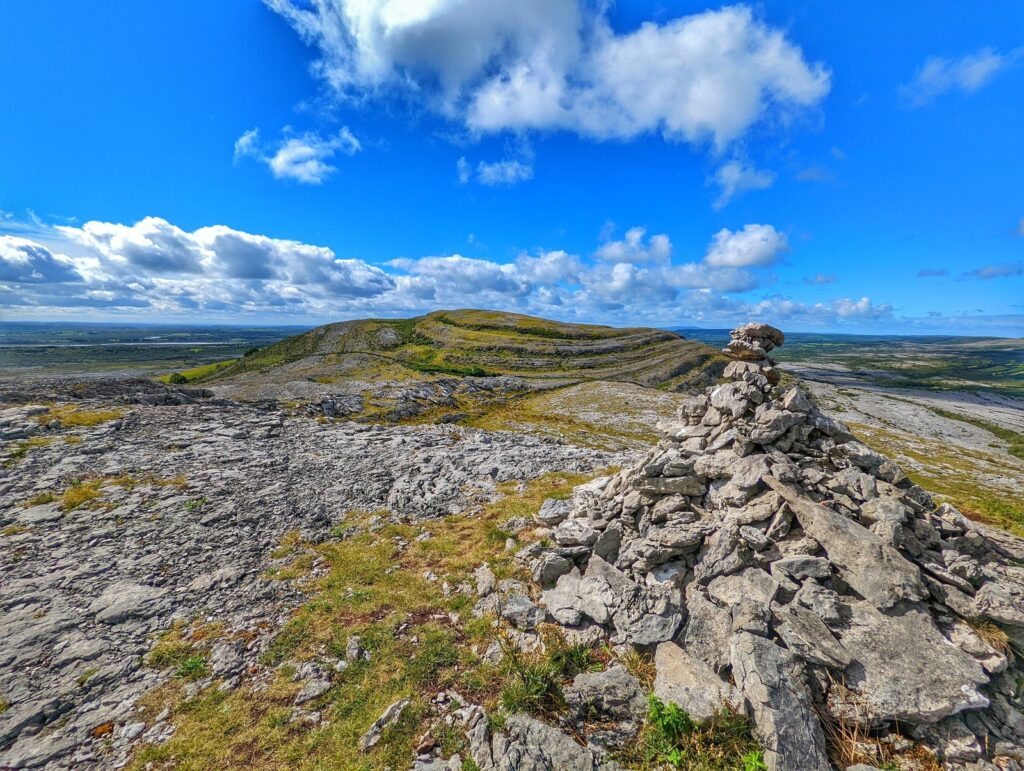
The Burren doesn’t look like the rest of Ireland. Instead of green fields and hedgerows, you’ll find a vast expanse of cracked limestone pavement that seems more moon than meadow. This 250-square-kilometer karst landscape in north County Clare is one of Europe’s rarest environments—a place where Arctic, Alpine, and Mediterranean plants grow side by side in the rock’s fissures, where Neolithic tombs crown the hilltops, and where underground rivers carve caves through the bedrock.
It’s stark, strange, and utterly compelling. Here’s how to explore it.
What Makes the Burren Special
The name comes from the Irish Boíreann, meaning “great rock”—and that’s exactly what it is. Formed from 350-million-year-old limestone laid down when this land was a tropical sea, the Burren’s surface has been scoured by glaciers and dissolved by rainwater into a fractured pavement of clints (blocks) and grikes (fissures). What looks barren from a distance is actually teeming with life: over 70% of Ireland’s native flora grows here, including rare orchids, bloody cranesbill, and gentians.
The landscape is dotted with some 70 megalithic tombs, ring forts, and early Christian churches. People have lived here for 6,000 years, drawn by the shelter the limestone provides and the thin but fertile soil in its cracks.
Where to Start: The Burren National Park
The best introduction to the Burren is Burren National Park, centered around Mullaghmore Mountain near the village of Corofin. The park covers about 1,500 hectares and is free to enter. Start at the visitor center in Corofin (open April through September), where you’ll find exhibits on the region’s geology, ecology, and archaeology.
From the parking area near the hamlet of Kilnaboy, several marked trails lead across the limestone terraces. The Mullaghmore Loop is a moderate 4-kilometer walk that climbs to a plateau offering sweeping views of Galway Bay and the Aran Islands. Along the way, you’ll pass ancient field systems and get a close look at the pavement’s fissures, many filled with wildflowers from May through August.
Wear sturdy hiking boots—the limestone is sharp, and the grikes can be ankle-deep.
Poulnabrone Dolmen and the High Burren
No visit is complete without seeing Poulnabrone Dolmen, the Burren’s most iconic monument. This 5,800-year-old portal tomb sits on a rise along the R480 between Ballyvaughan and Kilfenora, its massive capstone balanced on two uprights like a stone table. Excavations in the 1980s revealed the remains of over 30 people buried here, along with pottery and bone pendants.
There’s a small parking area, and the site is always open. Visit early in the morning or late in the afternoon to avoid tour buses and to see the dolmen in the best light.
From Poulnabrone, drive south on the R480 toward Kilfenora and stop at the pullouts to walk across the open pavement. This is the heart of the High Burren, where the limestone stretches in every direction and you can wander freely across the rock (always respect private property and close gates behind you).
Coastal Burren: Ballyvaughan and Black Head
The Burren meets the sea along the northern coast, where the Wild Atlantic Way curves around Black Head. The drive from Ballyvaughan northwest on the R477 (the Corkscrew Hill road) is spectacular, with the limestone rising steeply to the left and Galway Bay glittering to the right.
Stop in Ballyvaughan, a tidy village at the base of the hills, for lunch at one of the seafood pubs. The Burren Smokehouse on the harbor is worth a visit for its smoked salmon, made on-site using traditional methods.
If you’re interested in caves, book a tour at Aillwee Cave, just south of Ballyvaughan. This show cave offers a 30-minute guided walk through chambers and past an underground waterfall. It’s touristy but genuinely impressive, and the guides do a good job explaining how the cave formed. Tickets run about $17 for adults.
Practical Tips for Visiting the Burren
The Burren is best explored by car. The main routes—the R480, R477, and N67—form a loop that can be driven in a few hours, but plan a full day to stop, walk, and take it all in. Kilfenora, Ballyvaughan, and Lisdoonvarna make good bases.
Spring and early summer (May through June) are ideal for wildflowers. Autumn offers fewer crowds and moody light. Winter can be wet and windy, but you’ll often have the place to yourself.
Bring layers—the wind off the Atlantic can be fierce, even on sunny days—and pack water and snacks, as facilities are sparse once you’re out on the pavement.
If you want a deeper dive, consider a guided walk with one of the local experts. Viator offers half-day Burren walking tours that cover the geology, botany, and archaeology in detail.
Where to Stay and Eat
Ballyvaughan has a handful of guesthouses and B&Bs. Gregans Castle Hotel, a country house hotel on the Corkscrew Hill, offers upscale rooms and excellent dinners featuring local ingredients (mains around $35–$45).
In Kilfenora, stop at Linnane’s Lobster Bar in nearby New Quay for seafood with a view, or grab a pint and a bowl of chowder at one of the village pubs.
The Burren is only 40 minutes from Galway and an hour from Shannon Airport, making it an easy add-on to a west coast itinerary.
Want more stories like this delivered to your inbox? Subscribe to The Ultimate Ireland Travel Guide newsletter—one short story a day, guiding you deeper into Ireland’s landscapes, culture, and hidden corners.
Heads up — some links in this article are affiliate links. If you sign up through them, we may earn a small commission at no extra cost to you. We only recommend tools we use ourselves.