
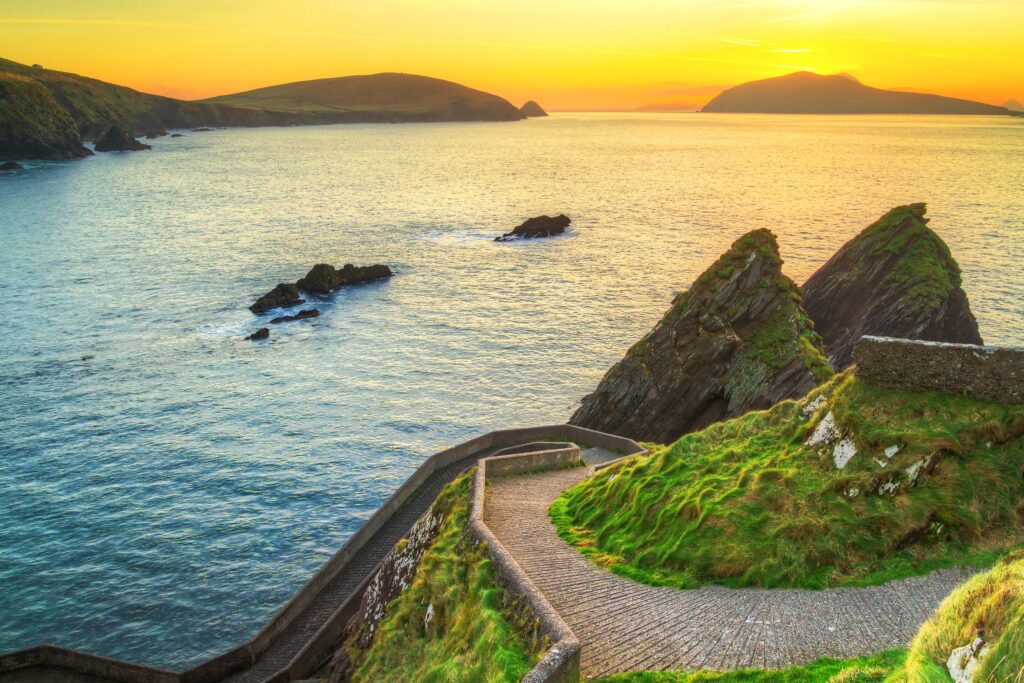
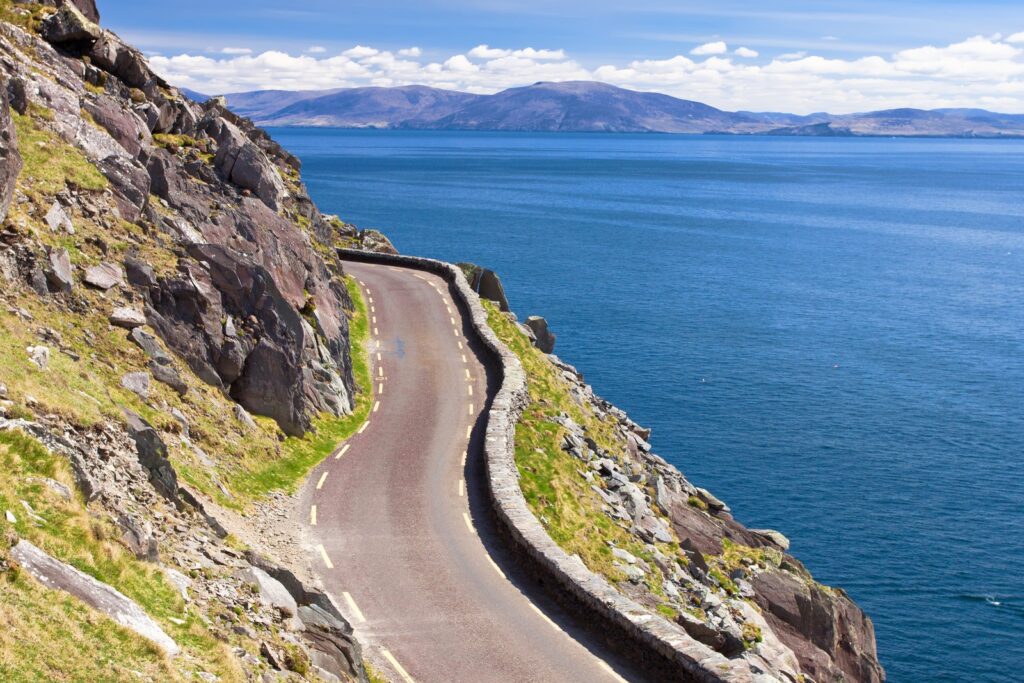
The Dingle Peninsula juts into the Atlantic like a crooked finger, wild and green and utterly unlike anywhere else in Ireland. While the Ring of Kerry draws the tour buses, Dingle—its neighbor to the north—remains quieter, more Gaelic, and just as spectacular. You’ll drive narrow roads over mountain passes, stumble on Iron Age forts, and hear Irish spoken in the pubs of Dingle town. This is Kerry at its most authentic.
The peninsula is compact—roughly 30 miles end to end—but you’ll want at least two days to do it justice. Base yourself in Dingle town and make loops from there, or drive the full Slea Head circuit in a day if you’re pressed for time.
Driving the Slea Head Loop
The Slea Head Drive is the spine of any Dingle visit: a 30-mile loop west from Dingle town that hugs the coast, climbs over headlands, and circles back through stone-walled farmland. Drive clockwise for the best views and easier navigation.
Leave Dingle on the R559 and you’ll pass Ventry Beach, a sweeping crescent of sand backed by green hills. A few miles further, the road narrows and the landscape turns dramatic. Stop at the Beehive Huts (Clochán an Aifir)—500 drystone structures built without mortar, likely used by monks or farmers over a thousand years ago. Admission is around $4, paid to the farmer whose land they’re on.
At Slea Head itself, the Blasket Islands come into view, haunting and uninhabited. Pull over at one of the viewpoints and take it in—on clear days, the light here is extraordinary. The Great Blasket Island was abandoned in 1953, but its memory lives on in the books written by its last inhabitants, available in every bookshop on the peninsula.
Continue north to Dunquin, where the road climbs steeply and the views open up over Dingle Bay. Stop at the Blasket Centre in Dunquin to learn the islands’ story before looping back east through Ballyferriter and Gallarus Oratory, an early Christian church built entirely of stone, still watertight after 1,200 years.
Conor Pass and the North Side
If you’re comfortable with narrow mountain roads, take the Conor Pass (R560) north from Dingle town. At 1,496 feet, it’s Ireland’s highest mountain pass, and the views—when the mist lifts—are staggering. The road snakes up through rock and scree, with sheer drops and no guardrails in places. Not for the faint of heart, but unforgettable.
On the north side, the landscape softens. Brandon Creek, where St. Brendan is said to have launched his transatlantic voyage in the 6th century, sits quiet and gray beneath Brandon Mountain. The village of Cloghane is a good base for hiking, with trails up Mount Brandon (3,127 feet), the second-highest peak in Ireland.
Dingle Town: Where to Eat and Sleep
Dingle town is the peninsula’s heart—a working fishing port with brightly painted shopfronts, excellent seafood, and a lively trad music scene. Stay at one of the family-run B&Bs along the waterfront or splurge on the boutique Dingle Skellig Hotel if you want a bit more comfort.
For seafood, head to Out of the Blue on the waterfront—no reservations, cash only, and they serve whatever came in that morning. Expect to pay around $30 for fish and chips or a seafood platter. Murphy’s Ice Cream, a local institution, is worth the queue for brown bread or sea salt flavors.
At night, Dick Mack’s or Foxy John’s are your best bets for traditional music. Both are true local pubs—no stage, just musicians in the corner and pints of Guinness passed overhead.
Practical Tips for Visiting
Rent a car—public transport on the peninsula is minimal. Drive carefully; roads are narrow, winding, and often shared with sheep. If you meet a tractor or tour bus on a single-track stretch, one of you will need to reverse to a passing place.
The best time to visit is May through September for weather, though April and October can be stunning if you don’t mind rain. Avoid July and August if you want solitude—the peninsula gets busy, especially Slea Head.
Bring layers. Even in summer, the Atlantic wind cuts through, and weather changes fast. A waterproof jacket is non-negotiable.
If you want to explore tours or experiences on the peninsula, Viator offers a range of guided options, from archaeology walks to boat trips to the Blaskets.
The Dingle Peninsula rewards slow travel. Take your time, pull over often, and don’t be surprised if a drive that should take an hour stretches into three. That’s the point.
Want one great Ireland story in your inbox every day? Subscribe to The Ultimate Ireland Travel Guide newsletter and we’ll send you the best of the island, one short read at a time.
Heads up — some links in this article are affiliate links. If you sign up through them, we may earn a small commission at no extra cost to you. We only recommend tools we use ourselves.