
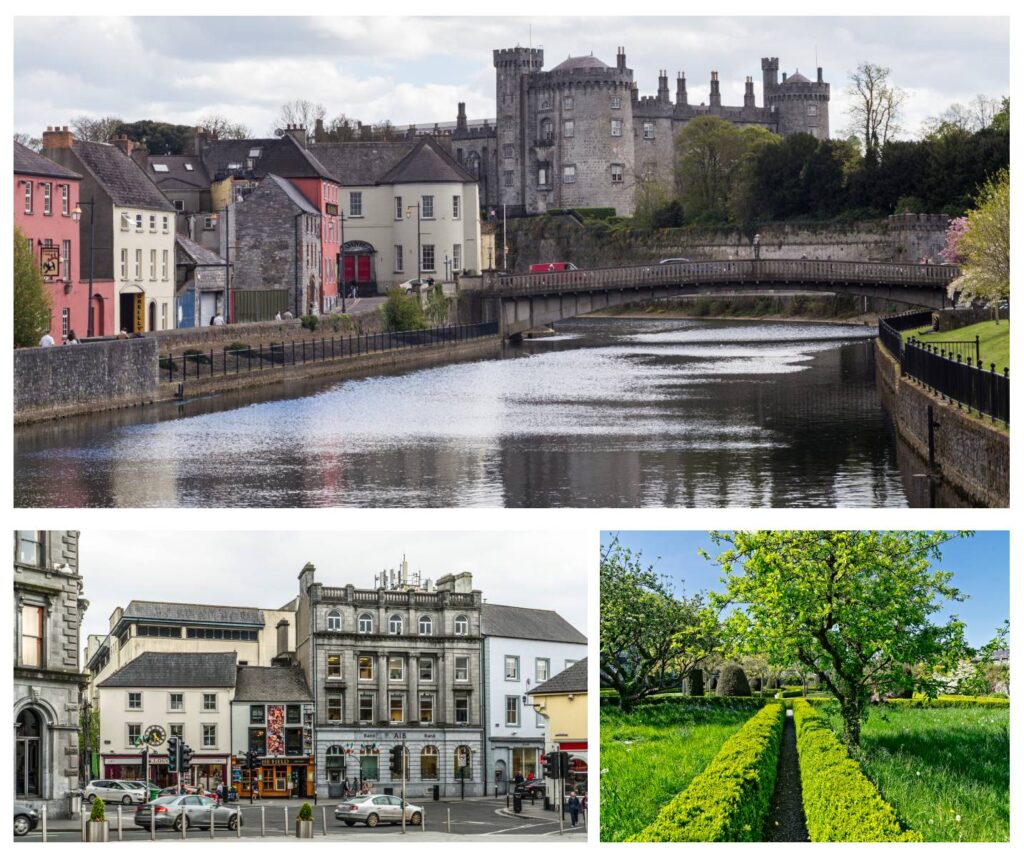
Kilkenny sits in Ireland’s Ancient East, 90 minutes southwest of Dublin, and it’s the country’s most intact medieval city. The compact center is built around a Norman castle, three cathedrals, and a warren of narrow lanes lined with stone townhouses. It’s walkable, unhurried, and packed with craft breweries, design shops, and traditional pubs that haven’t been scrubbed for tourists.
Two days is the right amount of time. You’ll have space to visit the castle, walk the Medieval Mile, eat well, and still spend an afternoon in one of the breweries or out along the River Nore.
Kilkenny Castle and the Medieval Mile
Start at Kilkenny Castle, the city’s anchor since the 12th century. The Butler family lived here for nearly 600 years, and the Long Gallery—with its painted ceiling and portraits—is worth the $10 entry alone. The grounds are free and slope down to the river; locals use them for picnics and running loops.
From the castle, follow the Medieval Mile north through the old city. You’ll pass the courthouse, the Tholsel (the old toll house), and a series of medieval alleyways called “slips”—Butter Slip and High Street both lead to hidden courtyards and cafés.
Stop at St. Canice’s Cathedral at the north end of the Mile. It’s the second-longest cathedral in Ireland, built in the 13th century on the site of a 6th-century monastery. The round tower beside it predates the Normans by 200 years. You can climb it for $6—it’s a tight squeeze, but the view over the Nore Valley is unmatched.
Where to Eat and Drink
Kilkenny has two working breweries and a dining scene that punches above its size. Smithwick’s Experience is the tourist-facing tour—it’s fine, but locals will point you to Sullivans Brewing Company on John Street instead. They brew small-batch IPAs and stouts in a old stone building with a taproom that’s open Thursday through Sunday. Tours run on weekends, $15 with tastings.
For food, Campagne on Gashouse Lane is the city’s Michelin-level spot—modern Irish with French technique, mains around $32. If you want something more casual, Foodworks on Parliament Street does seasonal plates and natural wine in a bright, tile-walled room. Ristorante Rinuccini on The Parade has been serving Italian since 1989 and still fills up most nights.
Kyteler’s Inn on Kieran Street is Kilkenny’s oldest pub, dating to 1324. It’s named after Dame Alice Kyteler, a local woman accused of witchcraft and the subject of Ireland’s first heresy trial. The building has low ceilings, flagstone floors, and a courtyard for warm evenings. Matt the Miller’s on John Street is darker, quieter, and better for a pint and the paper.
Day Trips and the Nore Valley
If you have a car, the countryside around Kilkenny is gentle, green, and underhyped. Drive south along the R700 to Inistioge, a riverside village 20 minutes away that’s appeared in half a dozen films. Park near the stone bridge, walk the loop trail along the Nore, and stop at The Motte for soup and brown bread.
Jerpoint Abbey is 15 minutes south of Kilkenny on the N9. It’s a 12th-century Cistercian ruin with intact cloisters and some of the best medieval stone carvings in the country. Entry is $6, and the site is managed by the Office of Public Works, so it’s well interpreted and rarely crowded.
North of the city, Dunmore Cave is a limestone cavern where Vikings massacred a group of locals in the 10th century. The guided tour takes 45 minutes and costs $5. It’s cold down there year-round—bring a jacket.
Practical Notes
Kilkenny is easy to reach by car or bus. From Dublin, take the M9 south; it’s about 75 miles and takes 90 minutes. Bus Éireann runs hourly service from Dublin’s Busáras for around $15 each way. The train station is a mile north of the center—you can walk it in 20 minutes or grab a taxi for $8.
Park at one of the public lots near the castle or along the river. Street parking in the center is metered and limited to two hours. Most B&Bs and guesthouses are within walking distance of the Medieval Mile. Pembroke Hotel and Lyrath Estate are the two upscale options; Butler House, in the old dower house behind the castle, is smaller and more atmospheric.
September and October are ideal—the city hosts the Kilkenny Arts Festival in August, which draws crowds, but by fall the pace slows and the weather is still mild. Avoid the last weekend in August unless you’re here specifically for Savour Kilkenny, the food festival.
Kilkenny doesn’t try too hard. It’s a working city with heritage baked in, not a museum. That’s what makes it worth the detour.
Get one short Ireland story in your inbox each day—subscribe to The Ultimate Ireland Travel Guide newsletter.