
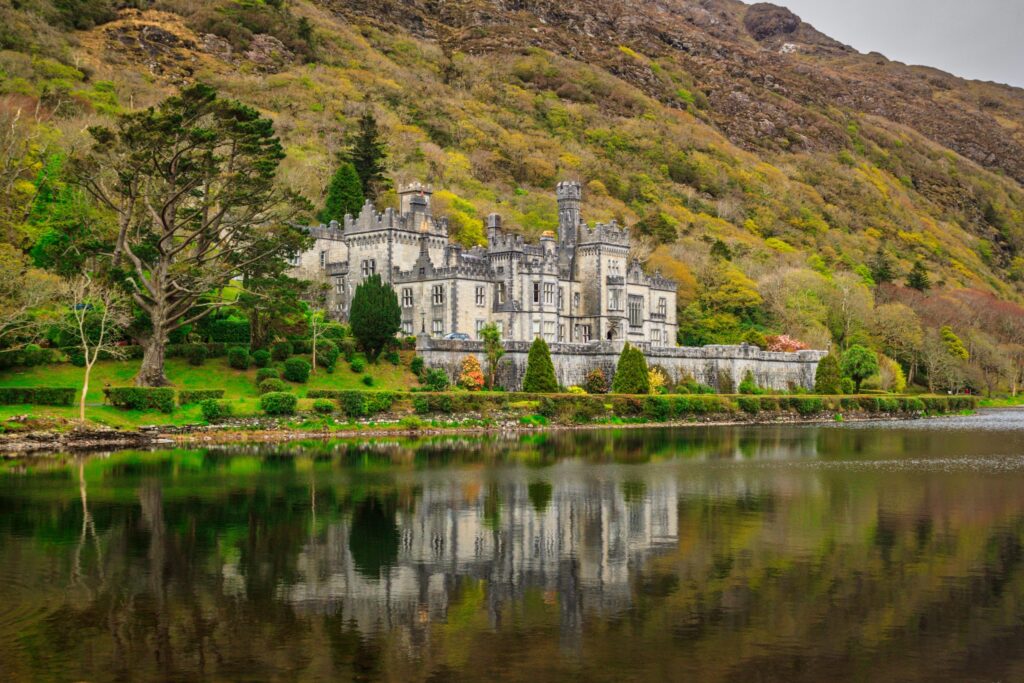
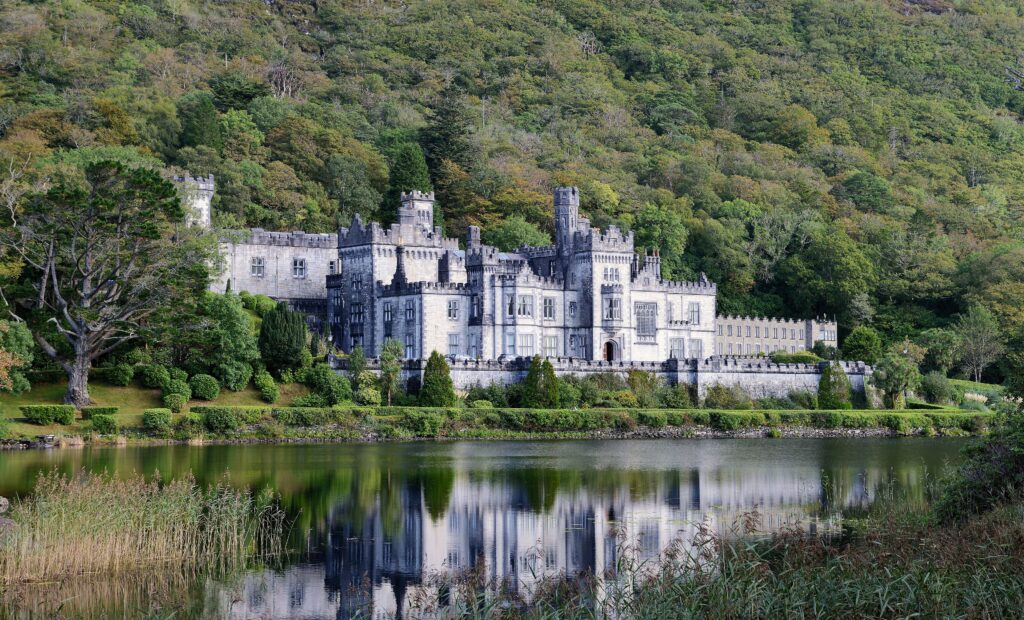
Kylemore Abbey sits on the northern shore of Pollacappul Lough in Connemara, County Galway—a turreted castle reflected in still water, backed by forested slopes and the Twelve Bens mountains. Built in 1868 as a private home and later converted to a Benedictine abbey, it’s one of Ireland’s most photographed landmarks, and it delivers on the promise of that postcard image.
But most visitors don’t realize there’s much more here than the castle itself. The estate includes a Victorian walled garden, lakeside woodland walks, and a Gothic church hidden in the hills. Here’s how to visit, what to see, and how to make the most of your time.
How to Get to Kylemore Abbey
Kylemore is located on the N59, about 50 miles northwest of Galway city and 12 miles east of Letterfrack village. If you’re driving the Connemara loop from Galway, it’s a natural stop between Clifden and Leenane.
From Galway, take the N59 through Oughterard and Maam Cross. The drive takes about 90 minutes and passes through some of Connemara’s most dramatic scenery—open bogland, stone-walled fields, and sudden glimpses of mountains and lakes. There’s parking on-site for $5.
Bus Éireann route 419 runs from Galway to Clifden and stops at Kylemore during summer months, but schedules are limited. A car gives you the flexibility to explore the wider Connemara region at your own pace.
What to See at Kylemore
Your ticket includes the abbey’s ground floor rooms, the Victorian walled garden, the Gothic church, and the woodland trails. Plan to spend at least two hours, longer if you’re a keen walker or gardener.
The abbey building itself was built by Mitchell Henry, a wealthy Manchester doctor, as a romantic gift for his wife Margaret. The guided rooms—reception hall, dining room, and library—are beautifully restored with period furniture, and the exhibit on the building’s history is genuinely interesting. The Benedictine nuns still live in the upper floors, so access is limited to the ground level.
The Victorian walled garden is a 10-minute shuttle ride from the main abbey (included in your ticket, or a 20-minute walk if you prefer). Restored over 15 years by the abbey’s nuns, it’s a six-acre garden with glasshouses, herbaceous borders, and vegetable plots. In summer, the roses and delphiniums are spectacular. There’s a small café here serving tea and cakes.
The Gothic church, built by Henry in memory of his wife after her death in 1874, is a short uphill walk from the abbey. It’s a miniature cathedral in grey limestone, with stained glass and marble columns, tucked into the woodland. Most visitors skip it, which is a mistake—it’s one of the most atmospheric spots on the estate.
Walking Trails and the Lakeshore
Two woodland trails loop through the estate. The shorter lakeshore path takes 20 minutes and offers the best views back toward the abbey. The longer trail climbs gently through oak and Scots pine to a viewpoint overlooking Pollacappul Lough and the Twelve Bens beyond.
Both trails are well-marked and suitable for most fitness levels. Wear decent shoes—the paths can be muddy even in dry weather. Early morning or late afternoon, when day-trippers have thinned out, the woods are quiet except for birdsong and the occasional bleat of sheep on the hillside.
Practical Information
Kylemore Abbey is open daily from 9:00 a.m. to 5:00 p.m. (extended hours in summer). Admission is $18 for adults, $15 for seniors and students. Book tickets online in advance during July and August—the abbey limits daily numbers to preserve the experience.
The on-site restaurant serves lunch and coffee in a bright dining room overlooking the lake. The menu is simple—soup, sandwiches, salads, scones—but well-executed, with ingredients from the walled garden when in season. Prices are reasonable for a visitor attraction: soup and brown bread for $9, a full lunch around $16.
If you’re staying nearby, Letterfrack village has several good guesthouses and is the gateway to Connemara National Park. Clifden, 10 miles west, has more dining and accommodation options. Kylemore works well as part of a longer Connemara drive, paired with a stop at the Twelve Bens, Killary Harbour, or the Sky Road near Clifden.
Photography is allowed throughout the grounds, and the classic shot—the abbey reflected in the lough—is best captured from the lakeshore path about 200 yards east of the main building. Mornings offer the calmest water and softest light.
When to Visit
Summer brings the fullest gardens and the longest daylight, but also the biggest crowds. May, June, and September offer a better balance—good weather, blooming plants, and fewer tour buses. The estate is beautiful in autumn, when the woodland turns copper and gold, though the gardens are winding down by October.
Winter visits are possible but more limited. The church and some trails may close in bad weather, and the garden is dormant. That said, a winter morning with mist rising off the lough and the mountains dusted with snow has its own stark beauty.
Avoid arriving between 11:00 a.m. and 2:00 p.m. in high season, when tour groups are thickest. An early start or late afternoon visit gives you space to wander without jostling for photographs.
Want more Ireland travel stories like this? Subscribe to The Ultimate Ireland Travel Guide newsletter and get one short story a day—castles, coastlines, pubs, hikes, and everything in between.