
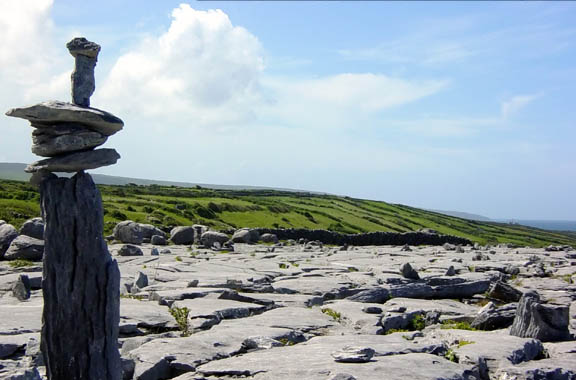
The Burren covers roughly 100 square miles of north County Clare, a sweeping moonscape of gray limestone pavement that looks like nothing else in Ireland. The name comes from the Irish Boireann, meaning “great rock”—and that’s exactly what you’ll find: vast expanses of cracked stone, disappearing rivers, hidden caves, and rare wildflowers blooming in the cracks. It’s eerie, beautiful, and worth at least half a day of slow exploration.
This isn’t a single landmark you can tick off a list. The Burren is a region, and the best way to experience it is by car, on foot, and with your eyes open for the small details that make it extraordinary.
Where the Burren Begins and What Makes It Strange
The Burren stretches from the coast near Ballyvaughan south to Corofin and west toward Lisdoonvarna. Geologically, it’s a karst landscape—limestone formed from ancient seabeds, then scraped clean by glaciers and weathered into fissures called grikes. In those cracks, wildflowers thrive: Arctic-alpine species next to Mediterranean plants, a botanical anomaly that has puzzled scientists for generations.
You’ll also find turloughs—seasonal lakes that appear and disappear depending on the water table—and a network of caves, some of which were inhabited 6,000 years ago. The Burren feels ancient because it is. Dolmens, wedge tombs, ring forts, and stone churches dot the plateau, remnants of Bronze Age farmers and early Christian monks who somehow made this hard land home.
The best overview is from the R480 between Ballyvaughan and Kilfenora, where the stone pavement spreads to the horizon and Galway Bay glimmers in the distance.
What to See and Where to Stop
Start at the Burren Centre in Kilfenora, a small museum that explains the geology, archaeology, and ecology in about 30 minutes. It’s not fancy, but it gives you context before you head into the landscape itself. Admission is around $7.
The Poulnabrone Dolmen, just off the R480, is the Burren’s most photographed site: a 5,000-year-old portal tomb balanced on limestone slabs. It’s free, right by the roadside, and usually crowded by mid-morning. Go early or late for the best light and fewer tour buses.
For a quieter ruin, drive south to Caherconnell Stone Fort, a restored ring fort with a small visitor center and sheepdog demonstrations. The fort itself is well-preserved, and the guides explain how these circular enclosures were built and used during the early medieval period. Admission is about $8, or $12 with the sheepdog show.
If you want caves, Aillwee Cave near Ballyvaughan offers 45-minute guided tours through underground rivers and caverns. It’s touristy but well done, and kids love it. Admission runs around $16. Nearby, the Birds of Prey Centre shares the same site if you’re interested in falconry displays.
Walking the Burren
The Burren is best experienced on foot. The landscape looks flat from the road, but up close it’s a maze of stone terraces, hidden valleys, and vanishing streams.
The easiest walk is the Burren Way, a marked trail that runs from Ballyvaughan to Lahinch. You don’t need to hike the whole thing—just pick a section. The stretch from Ballyvaughan to Fanore along the coast is about 8 miles and takes 3 to 4 hours, with views over Galway Bay and the Aran Islands.
For something shorter, try the trails around Mullaghmore, a rounded limestone hill south of the R480. The loop to the summit takes about 90 minutes and offers 360-degree views of the Burren and the Atlantic. The ground is uneven—wear sturdy boots and watch your footing in the grikes.
Another good option is the Green Road from Ballyvaughan toward Fanore, an old drovers’ path that cuts through the heart of the stone pavement. It’s about 5 miles one way, mostly level, and feels wonderfully remote.
Where to Eat and Stay
Ballyvaughan is the Burren’s main village and the best base if you’re staying overnight. It’s small, with a handful of pubs, cafés, and guesthouses. Monks Pub does decent seafood chowder and brown bread, and An Fear Gorta (“The Hungry Man”) serves solid pub food in a cozy, locals-heavy atmosphere.
For something nicer, Gregan’s Castle Hotel sits on the edge of the Burren with views over the valley. Rooms start around $200 a night, and the restaurant focuses on local lamb, cheese, and seafood.
Kilfenora is quieter, with just a couple of pubs and B&Bs. Vaughan’s Pub is the place to eat—traditional music most nights in summer, hearty stews, and a welcoming fire.
If you’re day-tripping, the Burren is an easy 40-minute drive from Galway or Doolin. Most visitors combine it with the Cliffs of Moher, but the Burren deserves its own time—this isn’t a landscape you rush through.
When to Visit
Spring is best, particularly May, when the wildflowers are at their peak and the stone comes alive with color. Autumn is quieter and still beautiful, with low light that makes the limestone glow. Summer brings crowds, especially around Poulnabrone, but the longer days are ideal for hiking.
Winter is atmospheric—empty, moody, and dramatic—but wet. The stone gets slippery, and some trails are harder to navigate. If you go between November and February, plan for rain and bring waterproofs.
The Burren doesn’t look like the Ireland of postcards, but it’s one of the country’s most distinctive and fascinating regions. Give it time, slow down, and let the strange beauty sink in.
Get one short story about Ireland every day. Subscribe to The Ultimate Ireland Travel Guide newsletter and we’ll send you the best of Irish travel, one story at a time.