
Glendalough—the Valley of the Two Lakes—is one of Ireland’s most spectacular early Christian sites. Founded by St. Kevin in the 6th century, this monastic settlement spreads across a wooded glacial valley in the Wicklow Mountains, where round towers, stone churches, and Celtic crosses rise between two dark lakes ringed by granite cliffs.
An hour’s drive south of Dublin, Glendalough draws crowds, but if you time it right and venture beyond the lower parking lot, you’ll find solitude, hiking trails, and one of the most beautiful spots in County Wicklow.
What You’ll See at Glendalough
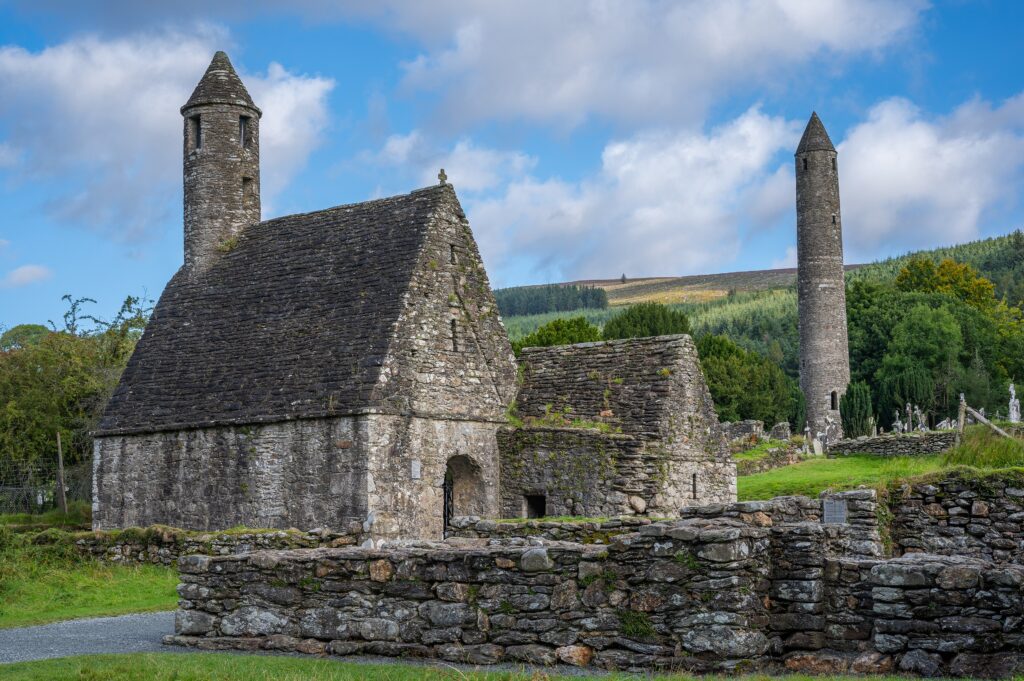
The monastic city spreads across two main areas. The Gateway and Lower Site sits near the Visitor Centre, where you’ll find the iconic 30-meter Round Tower—built around 1066 and nearly perfectly intact—along with the roofless Cathedral, St. Kevin’s Church (also called St. Kevin’s Kitchen for its distinctive stone roof and bell tower), and a collection of carved stone crosses.
The Gateway itself, a double stone archway, is the only surviving monastic gateway in Ireland. Walk through it and you’re stepping where pilgrims have entered for more than a thousand years.
A kilometer west along the Green Road footpath, the Upper Lake is quieter and wilder. Here you’ll find the Reefert Church ruins, a small Romanesque chapel tucked into the trees, and—if you’re willing to scramble—St. Kevin’s Cell and the Tempall na Skellig, perched on a rocky ledge above the lake. The cell is a tiny beehive-shaped stone hut where St. Kevin is said to have lived as a hermit. The climb is steep and narrow, but the view over the Upper Lake is worth it.
When to Visit and How to Beat the Crowds
Glendalough is mobbed between 11 a.m. and 3 p.m., especially in summer when tour buses from Dublin arrive in waves. Get there before 10 a.m. or after 4 p.m. and you’ll have the valley nearly to yourself. Autumn—late September through October—is especially beautiful, when the oakwoods turn gold and rust and the mist hangs low over the lakes.
Winter is stark and atmospheric, though the trails can be muddy. Spring brings wildflowers along the woodland paths. Whenever you visit, bring a rain jacket—Wicklow is wet, even when Dublin is dry.
If you’re coming by car, there are two parking lots. The lower lot near the Visitor Centre ($4 USD) fills first; the upper lot near the Upper Lake ($4 USD) is quieter and a better starting point if you want to walk the valley west to east, ending at the main monastic site.
Hiking Glendalough’s Trails
Glendalough sits within Wicklow Mountains National Park, and the valley is the trailhead for some of the best hikes in the east of Ireland. The Green Road is an easy, flat 2-kilometer walk connecting the two lakes through oak and birch woods—perfect if you’re short on time or traveling with kids.
The Spink and Glenealo Valley Loop is the classic Glendalough hike: a steep, rocky 11-kilometer circuit that climbs the cliffs above the Upper Lake, offering jaw-dropping views down into the valley, then loops back along the Glenealo River. It takes about four hours and requires good boots and a decent fitness level—the initial climb up the Spink is relentless, with wooden boardwalks clinging to the cliff edge.
The Wicklow Way, Ireland’s oldest long-distance trail, passes right through Glendalough. If you have a full day, hike south to Glenmalure or north toward Roundwood—both sections offer mountain views, heather moorland, and total solitude.
Practical Details
Glendalough is 50 kilometers south of Dublin via the M50 and R755. The drive takes about an hour, longer if you take the scenic route through the Sally Gap. There’s no direct public bus from Dublin, but Viator runs day tours that combine Glendalough with other Wicklow highlights if you’d rather not drive.
The Glendalough Visitor Centre ($5 USD) offers historical context and a short film, but you can explore the monastic site itself for free. The center opens at 9:30 a.m. daily from mid-March through mid-October, and 9:30 a.m. to 5 p.m. the rest of the year.
The Glendalough Hotel, right at the valley entrance, serves decent pub food and is a convenient spot for lunch or a post-hike pint. The Wicklow Heather Restaurant next door has better food—try the lamb stew or smoked salmon.
If you’re basing yourself nearby, the village of Laragh, two kilometers east, has a handful of B&Bs and the cozy Lynham’s Laragh Inn. Roundwood, ten kilometers north, is Ireland’s highest village and has excellent traditional pubs.
Glendalough is mystical at dawn, when mist rises off the lakes and the ruins are empty. It’s one of those rare places where Ireland’s deep past feels tangible—centuries collapse, and you’re standing in St. Kevin’s valley, just as pilgrims have for 1,500 years.
Want more hidden corners of Ireland delivered to your inbox? Subscribe to The Ultimate Ireland Travel Guide newsletter—one short story a day, taking you deeper into the Ireland beyond the guidebooks.
Heads up — some links in this article are affiliate links. If you sign up through them, we may earn a small commission at no extra cost to you. We only recommend tools we use ourselves.